
Faces Of Ancient Egyptian Mummies Have Been Reconstructed In 3D From Little DNA
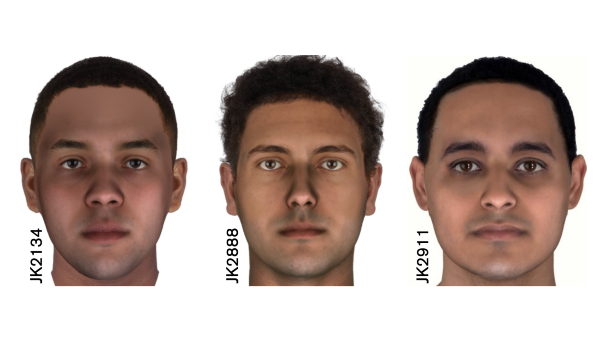
Image via Parabon NanoLabs
In an amazing feat, scientists have been able to create lifelike digital reconstructions of three Egyptian men, just by using DNA data from their mummified bodies.
The three mummies, which are thought to be over 2,000 years old, were found in Abusir el-Meleq, an ancient city in Egypt located to the south of Cairo.
In 2017, scientists at the Max Planck Institute for Science of Human History in Germany managed to sequence the remaining DNA—a world first at the time.
Now, researchers at Paragon NanoLabs in Virginia have gone a step further to reconstruct digital 3D models of the three men’s faces, based on a scientific process called phenotyping.
The method, called Snapshot, uses genetic details from the subject’s DNA to predict what they would’ve looked like at a certain age in time. This includes details such as ethnicity, skin color, and various physical features.
From the reconstruction, scientists were able to tell that the mummies’ appearances, which place them around 25 years old, were more closely linked to modern Mediterranean or Middle Eastern people, as opposed to modern Egyptians.
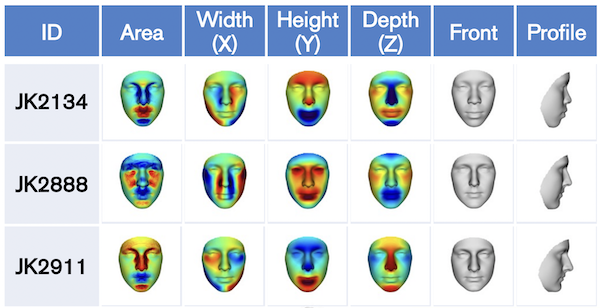
Image via Parabon NanoLabs
“This is the first time comprehensive DNA phenotyping has been performed on human DNA of this age,” Parabon NanoLabs said in a statement.
The team first created 3D outlines of the men’s facial features, before using heatmaps to point out the differences between the three faces. A forensic artist then combined these findings with Snapshot’s data to create the full images.
This achievement is a big step forward in phenotyping, with ancient human DNA being one of the most difficult to work with. Due to the age, what’s collected is usually degraded or mixed with other bacterial DNA, making it different to extract information from the sample.
“Between those two factors, the amount of human DNA available to sequence can be very small,” Ellen Greytak, Parabon’s Director of Bioinformatics, told Live Science.
Thankfully, with the advances in technology, scientists no longer need a subject’s entire DNA to reconstruct an image of their face.
Only specific points in the genome, known as single nucleotide polymorphisms (SNPs), need to be analyzed. These SNPs usually account for the physical differences among people.
Going forward, this breakthrough could be used to solve cold crime cases in which persons of interest are unidentified. Parabon NanoLabs researchers have worked on 175 cases so far, with nine solved using the same Snapshot method as with the mummies.
Take a look at the study’s findings below.
[via Live Science, images via Parabon NanoLabs]
Also check out these recent news


