
Michelangelo’s Marble Sculpture He Was Working On For His Tomb, Restored
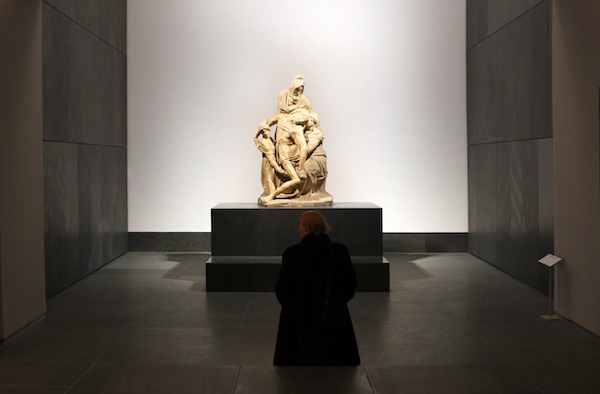
Image via Sailko / Wikimedia Commons (CC BY 3.0)
Almost like a gripping symbol of life and age, Michelangelo had agonized over the arduous process of a sculpture intended to accompany him in death. Between 1547 and 1555, when he was in his 70s, the artist worked on a marble statue of Jesus being held by the Virgin Mary, with Mary Magdalene by his side and the pharisee Nicodemus, whose image was portrayed in the likeness of the sculptor.
Cruelly, the marble block, meant to define his legacy and quite literally set it in stone, was impossible to work with. It was riddled with discolorations and impurities that caused the slab to spark when struck with the chisel.
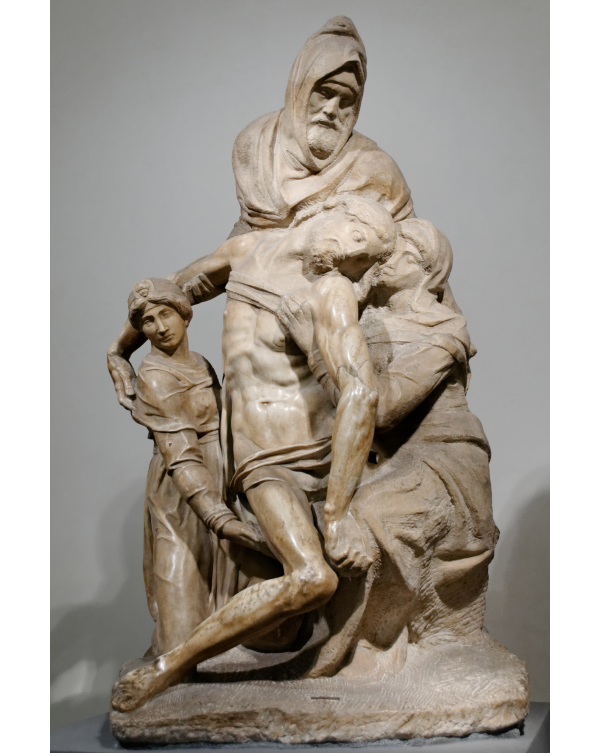
‘Bandini Pietà’ before the restoration. Image via Marie-Lan Nguyen / Wikimedia Commons (CC-BY 2.5)
In a fit of frustration, Michelangelo gave up on the sculpture, and it was never completed. His friend and biographer Giorgio Vasari noted that the artist had even been verging on destroying the monument.
Yet, nearly 470 years later, the statue lives, and the New York Times reports that the Bandini Pietà (also known as The Deposition and The Lamentation over the Dead Christ) has recently undergone its greatest restoration since it first saw the light of day.
Restoration experts enlisted by the Opera del Duomo Museum back in 2019 understood why the great artist was so tormented during his work on the sculpture. Research found traces of the metal-reactive mineral pyrite in the marble, causing it to spark with the metal chisel.
The block was also filled with hairline cracks Michelangelo wouldn’t have known about without striking onto it; he would have found out too late, inevitably shattering parts of the marble.
Then there were the intangible challenges. “This is Michelangelo’s most personal work, not only because it includes his own self-portrait and was destined for his tomb, but because it expresses the tormented relationship he had with marble,” the museum’s director Timothy Verdon told the Times. Its stubbornness to work with his chisel, a tool he was supposed to have mastered, aggravated the struggle.
Michelangelo decided to give the unfinished sculpture to his servant Antonio da Casteldurante as a present, who in turn handed it down to the artist’s pupil, Tiberio Calcagni. It was Calcagni who brought Bandini Pietà to its present appearance, though parts of it remain undone.
Imperfect marble aside, a plaster cast is to blame for the damage suffered by the statue through the years. In 1882, after a cast was taken of the work, the statue wasn’t cleaned well. To prevent further damage, it was regularly coated with layers of wax, stucco, and other materials, which all aged and caused the sculpture to oxidize.
At its worst, its exterior “looked like a Dalmatian,” said chief restorer Paola Rosa.
Since efforts to breathe new life in the monument began in 2019, visitors of the Opera del Duomo could watch the restoration take place in its open restoration laboratory, where experts endeavored to revive it to match “Michelangelo’s original idea of the sculpture.”
It would take centuries before the work would see the light at the end of the tunnel. The Times quotes that, when Michelangelo realized his biographer had been watching him work on the sculpture one night, the artist “let the lantern drop from his hand, leaving them in the dark.”
Michelangelo is believed to have explained: “I am so old that death often tugs me by the cape to go along with him, and one day, just like this lantern, my body will fall, and the light of life will be extinguished.”
[via The New York Times, images via various sources]
Also check out these recent news


