
National Gallery’s $9M Painting Declared Fake By AI, Backing Past Suspicions
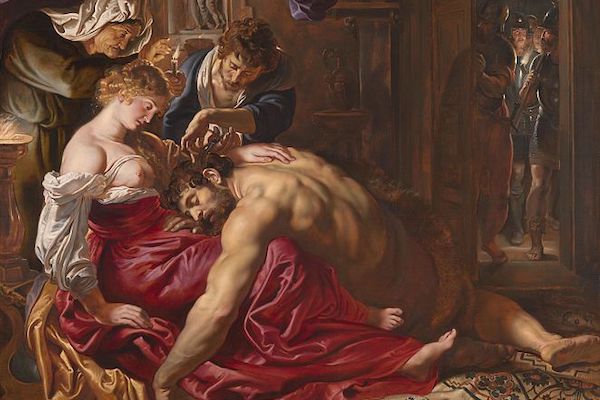
Image via the National Gallery
Among some of the most well-known works of Peter Paul Rubens, an influential Flemish artist active in the 17th century, is Samson and Delilah. This depiction of a Biblical story tells the tale of Samson, a warrior of the Israelites, betrayed by his Philistine lover Delilah.
Painted between 1609 and 1610, the art was purchased by London’s National Gallery in July 1980. According to an archived report from the New York Times, this made it the third-most expensive artwork ever auctioned during that time.
The Guardian states that it was sold for £2.2 million (US$2.98 million), which is equivalent to around £6.6 million (US$8.94 million) by today’s standards.
But now, analysis carried out by artificial intelligence (AI) has revealed that this painting, still displayed in the National Gallery of London today, may in fact be a fake.
Tests done on this piece by Swiss company Art Recognition utilized an algorithm that “learned” an artist’s unique characteristics by feeding the machine images of other examples of their work.
To further enhance this, smaller areas of the work are cropped and learned the same way in order to make sure that no detail goes missed.
After training, the algorithm is given a fresh image to test. Given the rigorous education it has just gone through, this should accurately show the likelihood of the artwork, Samson and Delilah in this case, being genuine.
And so, so merrily did the machine spit out the results after assessing the artwork against 148 other genuine Rubens pieces: 91% probability of being inauthentic.
“I was so shocked,” Dr Carina Popovici, the scientist who carried out the study, tells The Guardian. “We repeated the experiments to be really sure that we were not making a mistake and the result was always the same. Every patch, every single square, came out as fake, with more than 90% probability.”
While the result is undoubtedly shocking, there had already been doubts swirling about the authenticity of the painting. An article penned more than a decade ago is one of many that revealed how critics felt that the composition of the painting wasn’t quite right.
“They believe the picture is painted in a style that is more heavy-handed than the master's own renowned style,” German publication Der Spiegel wrote in 2005. “They also find it odd that, in the dramatic image, one of Samson’s feet is truncated.”
Although the National Gallery dismissed these concerns, it seems that they might have ended up being right.
Well, at least we know now that we have the technology in place to prevent incidents like this from happening again.
[via The Next Web, image via the National Gallery]
Also check out these recent news


