
Entrance Gate To Long-Lost Greek Temple Of Zeus Uncovered In Turkey
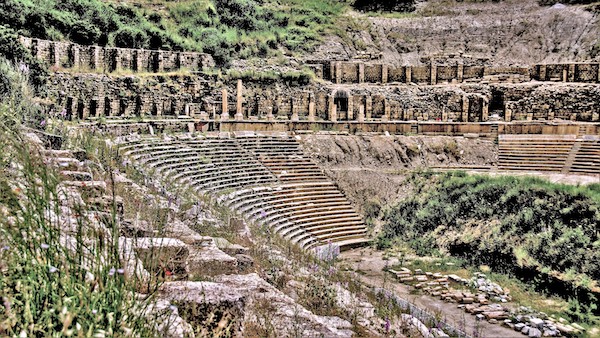
Image via Feridun F. Alkaya / Wikimedia Commons (CC BY-SA 2.0)
The unearthing of a 2,300-year-old Greek temple in the city of Magnesia, which is now modern-day Turkey, has a rather interesting backstory. Back in the 1890s, the site had been found by German archaeologist Karl Humann.
However, through the years, the site was reburied and forgotten about by many researchers. That was till Görkem Kökdemir, an archaeologist from Ankara University, unearthed it yet again, beginning over 20 years ago.
Kökdemir and his team of researchers have been on a roll with the discoveries, uncovering a sanctuary, stadium, theater, and over 80 statues and artifacts. More recently, as per Anadolu Agency, the team came across one of the area’s most-prized possessions: the entrance gate to the Temple of Zeus.
“We think that the temple we found in this area is a well-known temple in the history of architecture just like the Temple of Artemis, which is the fourth largest temple in Anatolia and also located in Magnesia,” Kökdemir told the Hürriyet Daily News.
Gate of #Zeus Temple discovered in western #Turkeyhttps://t.co/9f7ZBkHPsY pic.twitter.com/lRNH0KbLeJ
— Hürriyet Daily News (@HDNER) September 28, 2021
The gate is believed to date back to the third century BCE, with the city of Magnesia itself being established in fourth century BCE, as per TRT World. It’s also a fitting location to uncover a temple, as the site is considered one of the most sacred grounds in Magnesia.
“There is the Artemis sacred place there, there is also a sacred agora. The Zeus Temple is in the sacred agora. It is very significant. It is the second important cult [of Magnesia],” Kökdemir explained to TRT World.
According to the Smithsonian Magazine, ancient peoples often worshipped multiple deities, hence both the Artemis and Zeus Temples located within the same city.
Going forward, Kökdemir hopes to unearth 60% to 70% of the original building, with further plans to restore the temple—which had incredibly tall pillars and a high ceiling, as per the Greek Reporter.
Kökdemir reckons it’ll take a few years for the temple to be restored to its original glory (or what’s left of it), though the stadium—which could seat up to 50,000 people—will take another 15 to 20 years to be unearthed fully.
[via Smithsonian Magazine, cover image via Feridun F. Alkaya / Wikimedia Commons (CC BY-SA 2.0)]
Also check out these recent news


