
‘Worst Ad Campaign In The World’ Claims It’ll Still Outperform Google Search
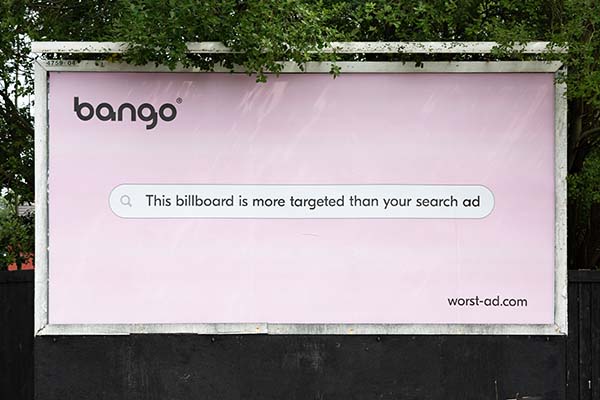
Image via Bango
Investing the funds to create the absolute worst-targeted advertising campaign in the world—and then buying up the space on a billboard known to be the least-viewed in the whole of the UK—sounds like a total nightmare for any business.
And yet that is what mobile commerce company Bango has just begun to do.
Proudly proclaimed and titled “The Worst Ad Campaign in the World,” the firm is centering its newest advertising around the fact that “search targeting is broken,” a conclusion that came from its latest study revealing that up to 35% of search advertisements never actually reach their targeted audience.
Over 65,000 impressions were investigated as part of Bango’s study, further revealing that in the advertisements that do end up where they’re supposed to, more than a quarter still don’t manage to be seen by those with buying intent.
Instead, they end up in very, very random places. In one example stated by Cambridge Network, an ad that was meant to target senior marketing professionals wound up being shown to students, doctors, supermarket cashiers, and a dog breeder.
And this was with a sum of US$171 billion spent on search advertising just last year alone.
Essentially, more than US$60 billion is being spent, every year, sending advertisements to specific audiences who never receive them.
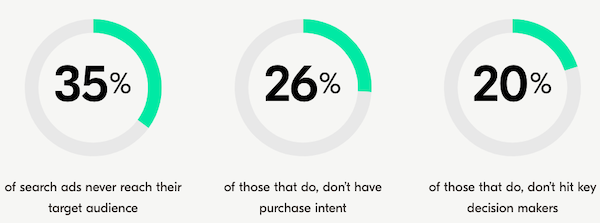
Image via Bango
This is why, Bango explains, it’s sticking with the one “lonely billboard,” which is said by ClearChannel to be the one that gets the least seen in the whole country. “Still,” it states, “we’re happy with our billboard. In fact, we’re confident that it’ll get more relevant eyeballs than a PPC advert shown at the top of Google.”
Rather than conventional search targeting, the firm is suggesting Purchase Behavior Targeting (PBT) instead. This uses payment data instead of search history to target shoppers based on their previous purchases.
“Don’t try to demographically ‘guess’ what kind of online audience might be interested in vegetarian food,” it points out. “Market to people who dine in vegetarian restaurants. It’s a simple as that.”
Calling all marketers! Search advertising is broken, and we can prove it. Head over to our blog to find out more about our cool new experiment, and discover how purchase behavior targeting can help fix it: https://t.co/ThXKAQjk37 #WorstAdCampaign pic.twitter.com/wUx4vUOlDf
— Bango (@bangodotcom) September 29, 2021
[via Cambridge Network, images via Bango]
Also check out these recent news


