
Salem Witch Trials’ Painful, Dark Past Unraveled In Grim Exhibits From The Time
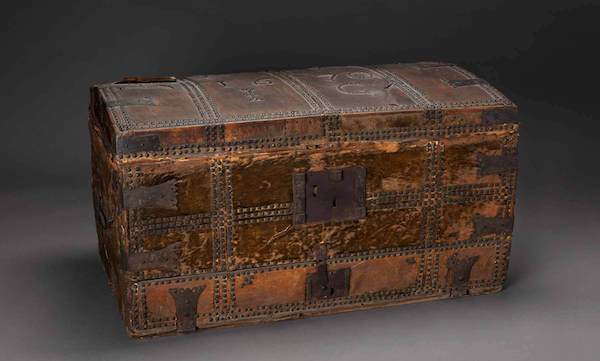
Image via English and American artist, Trunk, 1670, Wood, seal skin, iron, Boston or London, Gift of George Rea Curwen, 1898, 3970, © 2021 Peabody Essex Museum / Photograph by Kathy Tarantola
If you mention the Salem Witch Trials, most people would think of tales of the “dark age” when men and women were trialed and killed by villagers who inaccurately maligned them for witchcraft.
In total, more than 200 people were accused, with five men and 16 women believed to have been wrongfully hanged.
Now, those who are interested in learning more about the real story behind the folklore can visit a new exhibition at the Peabody Essex Museum in Salem, Massachusetts. The Salem Witch Trials: Reckoning and Reclaiming aims to show visitors what exactly happened in real life, with artifacts from that time in history.
The exhibition boasts an array of primary-source artifacts, such as letters and objects, which portray the people’s state of mind during the trials. It also provides a backdrop to why such a frenzy may have occured, such as there being an outbreak of smallpox or political instability within the colony.
The documents, which can be viewed online, include the testimonials defending John and Elizabeth Proctor, a couple who were killed during the trials. If their names sound familiar, it’s because playwright Arthur Miller had based his story, The Crucible, on them—lending their names to popular culture.
As Artnet News noted, it’s also fascinating to see how quickly the sentiment changed within the colony. Despite the killing of so many “witches,” courts were declaring the trials unjust only a decade later. By 1711, the heirs of those who were wrongly hanged had also received reparations from the community.
One segment of the exhibition pays tribute to Elizabeth How, an ancestor of famed fashion designer Alexander McQueen, who was one of the first women to be hanged in July 1692.
In fact, McQueen himself had named his 2007 Fall/Winter collection after her, In Memory of Elizabeth How, 1692. He took inspiration from the Salem Witch Trials, turning symbols which were once considered “dark” and “pagan” into contemporary outfits for women.
Tying the exhibition back to the current day is a display by photographer Frances F Denny, whose Major Arcana: Portraits of Witches in America segment depicts 13 women who identify as witches in the country today. It’s interesting how modern-day witches span a whole range of ethnicities and myriad practices.
In the era of misinformation and fake news, the exhibition’s co-curator, Dan Lipcan, hopes it will serve as a warning to how dangerous panic-induced groupthink can be.
“Thanks to these artists’ mining of Salem’s painful history, we are able to put these events into context with our lives today and imagine how we might courageously mold our communities moving forward while continually advocating for justice and tolerance,” he said.
The Salem Witch Trials: Reckoning and Reclaiming is currently on view at the Peabody Essex Museum in Salem, Massachusetts till March 20, 2022. For more information, head here.
[via Artnet News, cover image via Peabody Essex Museum]
Also check out these recent news


