
Marie Antoinette’s Secret Love Letters Uncovered Using X-Ray Technology

Image via Centre de Recherche sur la Conservation / French National Museum of Natural History
While Marie Antoinette, Queen of France, was married to then-King Louis XVI, she wasn’t penning love letters to him in her spare time. Instead, the monarch was sending intimate notes to a Swedish count, Axel von Fersen.
This secret relationship was well, secret. Both of them exchanged letters during the revolution, when the monarchy was held under house arrest in France. This could be one of the reasons the letters of their correspondence were censored, with someone coloring over the words in black ink.
However, with advances in technology, researchers are now able to read the exchanges. According to the Smithsonian Magazine, scientists at the French National Museum of Natural History have discovered a method of uncensoring correspondence, which could be use to unveil countless of historical documents, and even analyze fossils, which they document in a study.
Despite the danger of exchanging love notes during such a tumultuous time, it seemed that Marie Antoinette and Fersen couldn’t stop writing to each other. The censorship did get frustrating, however, with the queen writing: “Farewell, I am getting tired of ciphering; this is not my occupation and I am always afraid of making mistakes.”
Part of the reason why the letters had to be dealt with so carefully was, of course, that the Queen of France was writing love letters to someone other than the King. Other than that, they also included information of the pair’s political plans, which could land either of them into trouble should it be uncovered by the revolutionaries.
Fersen’s remaining letters were bought from the family by the French National Archives in 1982, though researchers weren’t able to read parts that were covered in ink. The team looked into its chemical composition using an x-ray fluorescence spectroscopy, which produces fluorescent ‘fingerprints’ unique to the ink used.
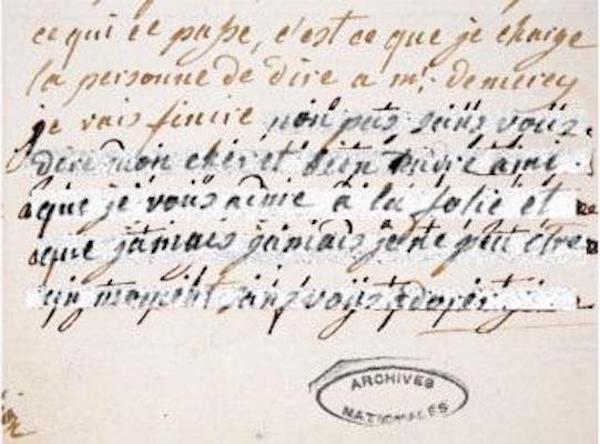
Image via Centre de Recherche sur la Conservation / French National Museum of Natural History
This helped researchers uncover what the different inks used were made up of. With new information about their makeups, the scientists were able to program computer algorithms to maximize the differences in ingredients, allowing the censored writing to appear more legible.
Using this method of reversing the censors, the team discovered that some of the queen’s letters had been copies of Fersen’s, both writing with the same ink. That very ink was also used by the censor, which points to Fersen as the mysterious figure redacting their correspondence.
Despite the fact there’s no outright mention of a physical relationship within the letters, many take the notes as proof of a love affair that spanned countries. It’s also telling that Fersen blotted out words such as “beloved,” “tender friend,” and “adore,” alluding to his desire to keep their relationship under wraps.
“The redacted passages are the most intimate passages of the correspondence,” said Anne Michelin, a physical chemist from the team.
“Fersen probably wanted to keep this correspondence, important to him perhaps for sentimental reasons or political strategies, while protecting the queen’s honor and perhaps his own.”
With this new technology in play, who knows what ancient secrets scientists can uncover next.
[via Smithsonian Magazine, images via Centre de Recherche sur la Conservation / French National Museum of Natural History]
Also check out these recent news


