
Rare Three-Eyed ‘Dinosaur Shrimp’ Emerge After Heavy Rain In Arizona
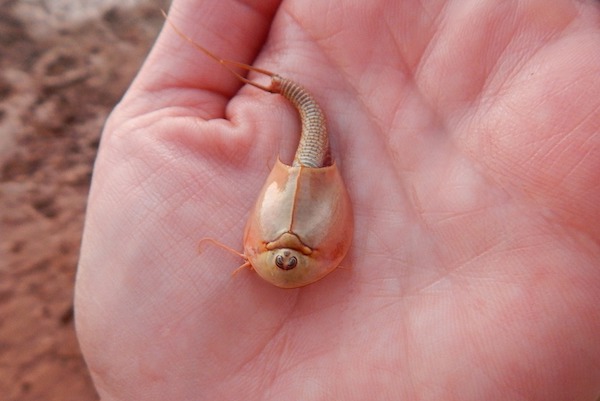
Image via Wupatki National Monument
This summer, northern Arizona saw heavy rainfall. This brought about the arrival of some very strange-looking creatures, taking up residence in a temporary lake in the desert near the Wupatki National Monument.
Around the same size as a tadpole, they “look like little mini-horseshoe crabs with three eyes,” according to Lauren Carter, lead interpretation ranger at Wupatki National Monument, in a statement provided to Live Science.
These are known as Triops, which is Greek for “three eyes.” But because of their lengthy history of evolution, they’re also sometimes known as “dinosaur shrimp.”
Eggs of the prehistoric crustaceans can lay dormant without hatching for decades, surviving the desert until sufficient rainfall creates mini lakes, like the one this batch was found in.
Only then will the hatchlings successfully mature and reproduce, and the cycle goes on.
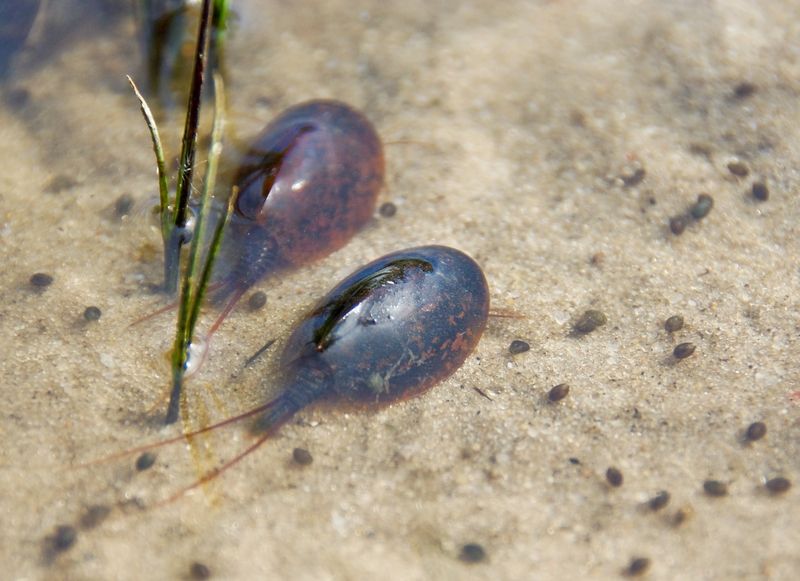
Image via ID 14924039 © Frogtravel | Dreamstime.com
Due to these stringent conditions, they’re not a common sight. So when tourists reported “tadpoles” at the temporary lake formed at the monument’s ceremonial ball court, personnel began to investigate what they believed were toads—only to find the unusual Triops instead.
“I just scooped it up with my hand and looked at it and was like ‘What is that?’ I had no idea,” Carter recalls. However, thanks to a previous encounter at a different park in northeastern Arizona, she suspected that it could be this elusive species.
Although these creatures have evolved since their origins millions of years ago, their outward appearance hasn’t changed drastically, if at all. Growing up to 1.5 inches long, they have somewhat of a helmet-like structure and sport a trio of eyes.
Two of these are large compound eyes, similar to that of an insect. The last is a smaller ocellus—a simple eye—nestled neatly in between them. As stated by the Amateur Entomologists’ Society, the ocellus helps the creatures to detect light.
Triops are capable of living up to 90 days, just enough to reproduce and ensure the continuity of the species. However, the temporary lake they were found in had dried up within a month. Left homeless, they didn’t manage to last as long as they could’ve before birds sighted them and made a hearty meal.
Before they went, though, they might’ve been able to lay some eggs. But until the next monsoon hits and the temporary lake fills back up again, we won’t know.
[via Live Science, image via ID 14924039 © Frogtravel | Dreamstime.com]
Also check out these recent news


