
Drones Have Evolved, And This One Can Freakishly Walk On Its Two Feet
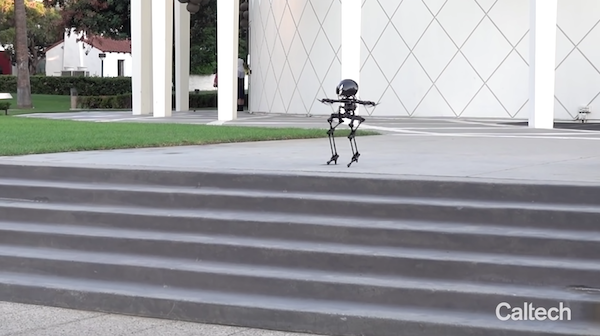
Video screenshot via Caltech
Like a legendary polymath of the same name, LEONARDO the flying drone is paving the way for new innovations. Its name is short for LEgs ONboARD, so—you guessed it—it walks too.
Now that you’re acquainted, you can call this bipedal robot LEO, which is the nickname its inventors at Caltech prefer to call it by. LEO can transition between walking and flying, which is more challenging to accomplish than it really sounds.
To make a drone that also walks on legs, engineers would have to consider locomotive domains for both walking and flying, which understandably presented “a rich set of engineering problems” other robotic projects didn’t have to encounter.
LEO had to stay balanced on the ground while being agile in flight, like “the way birds are able to flap and hop to navigate telephone lines,” explained Soon-Jo Chung, Bren Professor of Aerospace and Control and Dynamic Systems. This required durable parts that also had to be lightweight.
Image via Caltech
LEO is, quite figuratively, still taking its baby steps. For now, it is a prototype meant to explore how bipedal flying robots can cover blind spots of aerial drones or ground robots.
The bot has a height of a wee 2.5 feet and weighs in at 5.7 pounds. It walks around on built-in “high heels,” which keep it balanced while standing, as counterintuitive as it sounds.
To prepare for flight, LEO’s thin but multi-jointed legs give it a boost, while its propellers keep it in the air. The latter happens to keep LEO upright on the ground too.
LEO’s torso is filled with its processor, batteries, and sensors, keeping messy wires away from view, Gizmodo reports.
What’s worth noting is that it’s “not a priority” for LEO to run on an efficient energy system. This project only sets to develop a robot specializing in hybrid locomotion, allowing it to walk and fly with equal ease.
As for its funny looks, the team told Gizmodo that LEO isn’t just based on creatures of nature, but they also drew from the sci-fi appearances of flying humanoid Astro Boy and Gravity Industries’ real-life jet suits.
The dream is to create an advanced version of LEO that can even handle difficult tasks, like installing equipment in less accessible areas, inspecting and fixing infrastructure, and navigating a scene after a natural disaster.
[via Gizmodo, video and images via Caltech]
Also check out these recent news


