
24/7 ‘Roboats’ Embark On Amsterdam’s Canals As Self-Navigating River Taxis
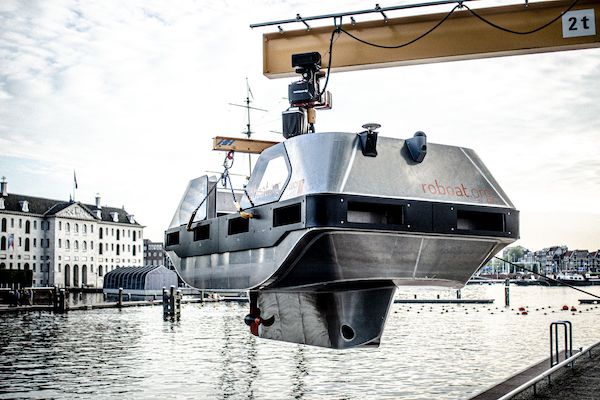
Image via Roboat / MIT
Researchers from the Massachusetts Institute of Technology’s (MIT) Computer Science and Artificial Intelligence Laboratory (CSAIL) have worked together with the Senseable City Laboratory, and the Amsterdam Institute for Advanced Metropolitan Solutions (AMS Institute), to invent a fully-autonomous robotic boat.
Named the ‘Roboat’, the self-navigating device made a splash in the canals of Amsterdam last week, and going forward, will continue to ferry passengers across the water without the need for a skipper to physically man the boat.
According to Interesting Engineering, not only can the two full-scale vehicles carry up to five people on the water at once, they’re also able to collect waste, deliver goods to the other side of the embankment, and provide on-demand services to businesses in the area.
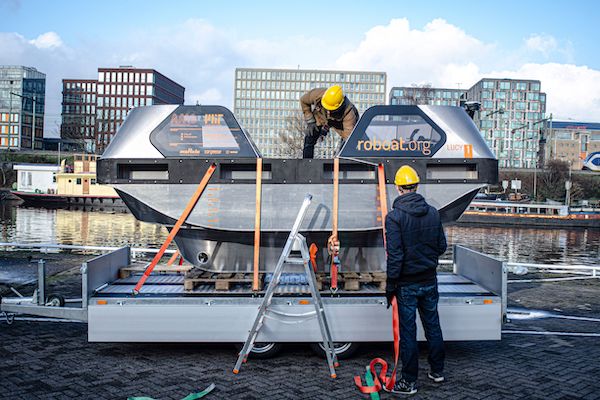
Image via Roboat / MIT
Upon first look, the fully-electric boat appears futuristic in its signature black, silver, and gray colorway, with its name spelled out in bright, orange letters on the front. Not only does it resemble something out of a sci-fi movie, but it’s also got the hidden functions to match.
Researchers designed the boat so that it dons a universal hull design, featuring the same base throughout, but its top decks can be rotated depending on which particular task it is being used for.
“We now have higher precision and robustness in the perception, navigation, and control systems, including new functions, such as close-proximity approach mode for latching capabilities, and improved dynamic positioning, so the boat can navigate real-world waters,” said Daniela Run, MIT Professor of Electrical Engineering and Computer Science.
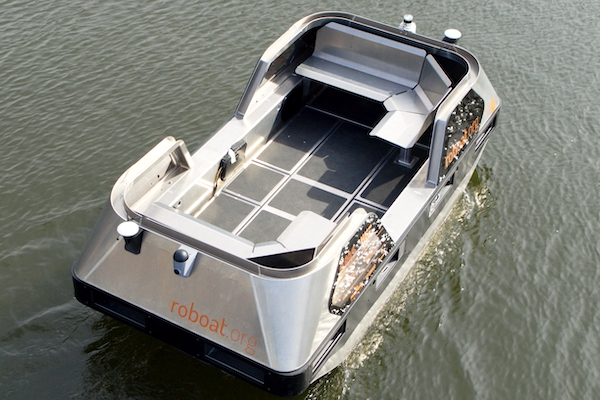
Image via Roboat / MIT
In addition, the boat comes with LiDAR sensors, as well as numerous cameras, equipping it with a 360-degree vision to identify any oncoming crashes. While the boat is able to drive around on its own in the waters, there will still be an operator present onshore to steer it using a remote controller should anything crop up.
“As Roboat can perform its tasks 24/7, and without a skipper on board, it adds great value for a city,” explained Fabio Duarte, a lead scientist on the project.
“However, for safety reasons it is questionable if reaching Level A autonomy is desirable. Just like a bridge keeper, an onshore operator will monitor Roboat remotely from a control center. One operator can monitor over 50 Roboat units, ensuring smooth operations.”
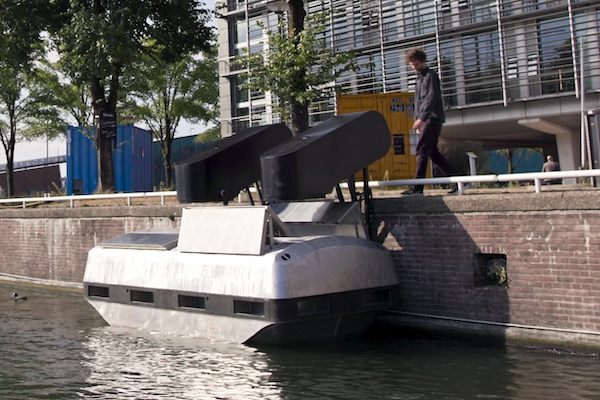
Image via Roboat / MIT
[via Interesting Engineering, images via Roboat / MIT]
Also check out these recent news


