
Right-Angled Solar System With Mysterious Forces Behind It Is The First We Know
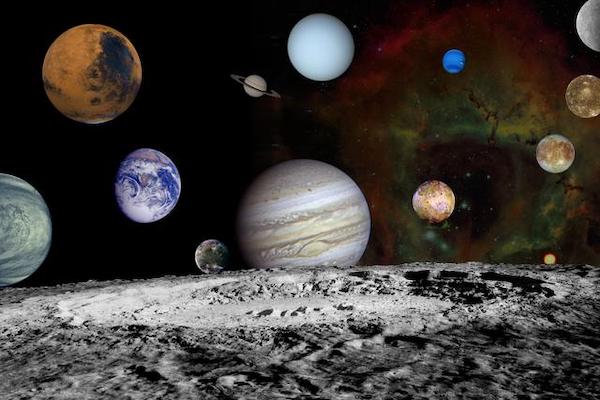
Impression of our solar system and its planets. Image via NASA / JPL / ASU
Conjure up an image of a solar system and its planets in your mind, and you’ll find that they’re most likely going to be dotted around the Sun’s equator in circular, horizontal orbit.
New research, however, shows that this might not be true for other galaxies. A study led by Vincent Bourrier of the University of Geneva shows there is a possibility of a vertical, right-angled star system.
“Two planets orbit the poles while another revolves around the star’s equator, suggesting a mysterious, undetected force,” summarizes The New York Times. This is markedly different to what we’ve always known, which is no planets on the poles and all of them around the equator instead.
This discovery was made via an instrument called ESPRESSO, located on the Very Large Telescope in Chile.
“If you had a telescope and you were looking at the trajectory of the other planets in the system, they would be going vertically in the sky,” explains Bourrier to the news outlet.
In the study published in the journal Astronomy & Astrophysics last month, the researchers also measured the orbit of the innermost planet, HD 3167 b, for the first time. This doesn’t match the other two planets’ orbit; instead, it orbits in the star’s flat plane, which is more like planets in our solar system.
But this means that it’s perpendicular to its siblings, HD 3167 c and d, which are also dubbed “mini-Neptunes.” There has never been another known star system that acts in this way.
Another scientist by the name of Shweta Dalal, from the University of Exeter, has also investigated the system separately to Bourrier’s study. According to Dalal’s findings, there may be another planet the size of Jupiter orbiting the star every 80 days.
Its gravitational effect would potentially be enough to induce the strange orbits of the two planets on the star’s poles, while the innermost planet—the horizontal, “normal,” one—remained in a regular orbit because it was tightly bound to the star itself.
However, this hasn’t yet been confirmed, although further ESPRESSO observations could help with further investigation. “The path is therefore clear for the researchers, who are now setting out in search of this elusive companion,” writes the University of Geneva’s press release.
[via Boing Boing, cover image via NASA / JPL / ASU]
Also check out these recent news


