
Eco High-Rise Building Design Traps Greenhouse Gases With Hemp & Algae
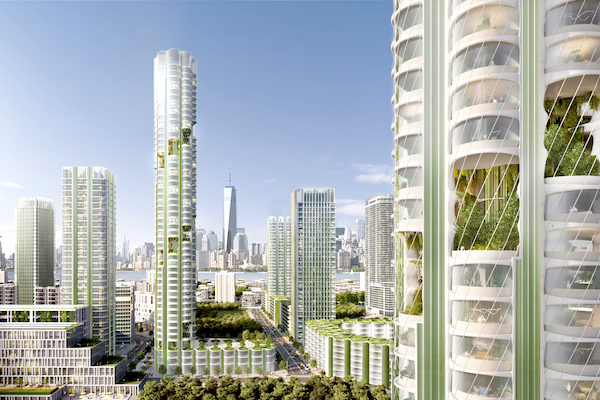
Image via SOM | Miysis
Architecture firm Skidmore, Owings & Merrill (SOM) has come up with an ingenious way of designing buildings so that they absorb more greenhouse gases than produced, which could help solve the long-term problem of emissions from the construction industry.
The team recently presented its findings at the COP26 United Nations climate change conference, showing off an idea for a high-rise that could absorb more carbon dioxide than emitted during its construction.
Named the ‘Urban Sequoia’, the team proposed the building be wrapped with an algae-filled façade, which can produce biofuels to power the building, instead of relying on external fossil-fuel sources.
Within the structure, components can be made out of biological material—such as insulation made from hemp—to take in carbon dioxide from the building’s surroundings. There could also be built-in air capture systems to suck carbon emissions out of the air.
Although it sounds rather futuristic, Fast Company noted that all the technologies needed to create such a building already exist today. By combining them all, architecture companies could come up with the perfect solution to house the world’s growing population while keeping the industry’s ecological footprint to a minimum.
“There’s a recognition that buildings play a major role in carbon emissions. And as architects who build lots of buildings, we play a role in that and we have the potential to help make change,” said SOM partner, Chris Cooper.
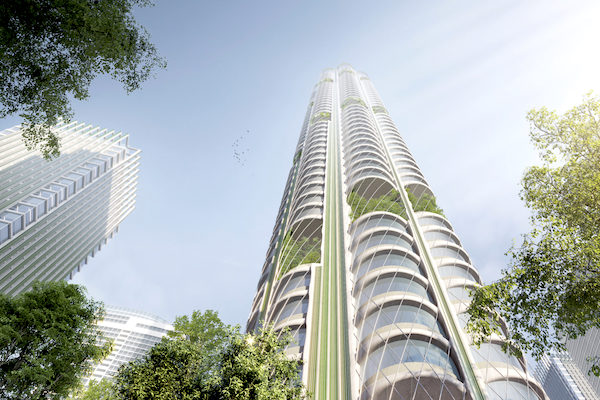
Image via SOM | Miysis
Yasemin Kologlu, principal at SOM, said that carbon-absorbing buildings could very well be built now. Carbon sequestering materials, such as hemp, have been used in multiple buildings around Europe, such as a sports center in Paris. In addition, carbon capture systems are fast improving, and could very soon become an effective way of eliminating emissions in the air.
“It’s not a hypothesis. We just need to look beyond our building industry into other industries, and leverage some of the technologies and systems that exist,” she said.
Moving forward, SOM hopes to start proving the concept with building prototypes. Cooper explained: “That can be a pavilion made of bio brick that’s absorbing carbon, that’s almost an easy solution, or it can be a tower that has direct air capture and materials that absorb carbon.”
Hopefully, in the near future, SOM will see its partnerships with universities and industry leaders pay off as it attempts to build the world’s first carbon-absorbing building, setting a new standard for the industry.
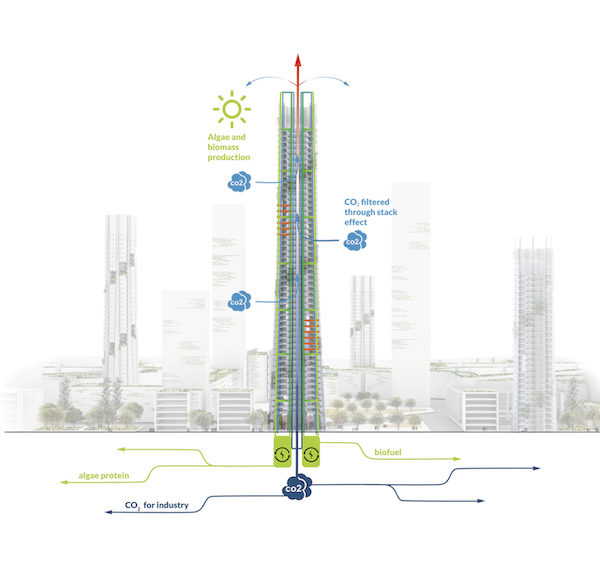
Image via SOM | Miysis
[via Fast Company, images via SOM | Miysis]
Also check out these recent news


