
Bird-Like Drone Has ‘Falcon’ Legs To Land & Perch On Branches
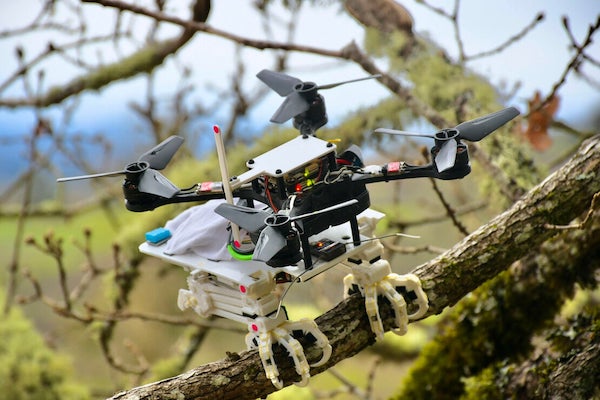
Image via Stanford University
It’s a bird! It’s a drone! It’s… a bit of both. In hopes to find ways for flying robots to catch objects and conserve power while in the air, Stanford University engineers turned to nature’s pilots for help.
Specifically, they were fascinated by the way birds land and perch on branches, a skill that the winged creatures developed after millions of years on Earth. With evolution, birds have soft, wrinkly toe pads that offer friction as they curl their claws around an object.
By replicating this skill, future drones might also be able to take off from any place instead of just flat ground.
As simple as the birds have made perching look, however, mimicking the motions of landing and perching on a flying robot is tricky. This is because nature isn’t uniform—branches come in infinitely different shapes, sizes, and textures, and can be covered in moss, lichen, or drenched in rain.
“We want to be able to land anywhere—that’s what makes it exciting from an engineering and robotics perspective,” David Lentink, one of the engineers, told AFP.
To build their bird bot, the team looked at footage they had collected of parrotlets, the second-smallest parrot species, watching the birds perch on a range of materials like wood, foam, sandpaper and Teflon. They realized that the parrotlets’ feet handled all surfaces—which had sensors to detect force—in the same way, no matter the difficulty, material, or size of the perches.
From there, the engineers developed a system they called “stereotyped nature-inspired aerial grasper,” or SNAG for short, with “stereotyped” implying the similar behavior birds handle branches.
They modeled their grasper after the legs of a peregrine falcon, as it had to be large enough to accommodate a small quadcopter drone. Motors and fishing line served as the robobird’s “muscles” and “tendon.”
As the “feet” grip around a branch, an accelerator in the right foot lets the drone know it has landed. A balancing algorithm would then be activated to keep the robot from falling.
It took about 20 3D-printed prototypes before the team landed on the final design. In tests, the drone could catch thrown objects like tennis balls and bean bags, as well as successfully landed in real Oregon forests.
Not only would the technology be insightful in the development of future aviation bots, but the team also thinks it could teach scientists more about the evolution of birds. During this study, they learned that the gripping ability of birds with three front toes isn’t any superior to that of birds with two front toes, which suggests that the difference isn’t to do with clutching.
[via SlashGear and AFP / France 24, cover image via Stanford University]
Also check out these recent news


