
‘Extremely Rare’ 1650 Artwork Of Black & White Companions Barred From Exiting UK
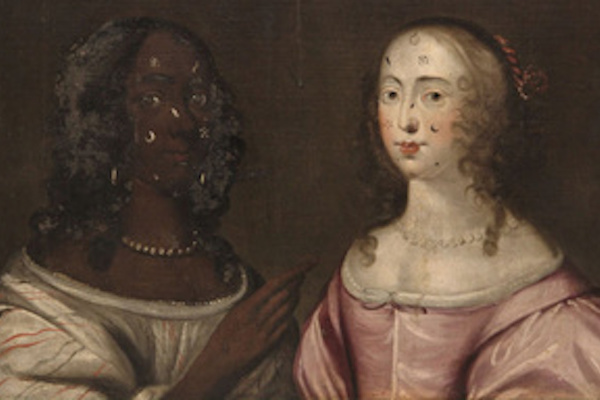
Image by Department for Digital, Culture, Media & Sport, Arts Council England, and Lord Parkinson of Whitley Bay, via Gov.uk
A temporary export bar has been placed on an “extremely rare” painting by the British Government’s Department for Digital, Culture, Media & Sport (DCMS), the Arts Council England, and Arts Minister Lord Parkinson of Whitley Bay.
This essentially means that the painting isn’t allowed to leave the country until March 9, 2022, buying time for a UK buyer or institution to purchase the work.
Valued at £272,800 (US$361,500) and dated back to 1650, the painting is, to this day, anonymous. Titled Allegorical Painting of Two Ladies, English School, the painting depicts two ladies sitting side by side, one Black and one White, as counterparts.
While it was already uncommon for a Black woman to be portrayed in a painting of the time, instead of “a child in a position of subordination,” it’s made even rarer by the fact that the two ladies don similar dress, makeup, and jewelry—painting them as equals.
“This fascinating painting has so much to teach us about England in the 17th century, including in the important areas of race and gender, which rightly continue to attract attention and research today,” states Parkinson, who decided to impose the export bar alongside the Reviewing Committee on the Export of Works of Art and Objects of Cultural Interest (RCEWA).
“I hope a gallery or museum in the UK can be found to buy this painting for the nation, so that many more people can be part of the continuing research and discussion into it.”
Another “remarkable” point to the artwork comes in the form of beauty patches, worn by both women. This was, according to the press release, “in vogue” at the time—but the painting seemingly condemns the two for donning them. An inscription claims that wearing these beauty patches is a “sin of pride,” reflecting a widespread notion in the 17th century.
As pointed out by the DCMS, the style of the painting is similar to that of popular woodcut prints at the time, which gives the work its allegorical nature. It’s also, therefore, associated with satirical verse, pamphlets, and sermons.
“Although not distinguished artistically, its imagery relates in fascinating ways to contemporary stereotypes of women, fashion, and, through the juxtaposition of the figures, race,” comment RCEWA members Pippa Shirley and Christopher Baker.
The fact that it can be used to study important facets of Black culture in Britain “makes it particularly important that it remains in this country so that its meaning can be widely studied and understood,” they conclude.
[via CNN, cover image via Gov.uk]
Also check out these recent news


