
Cancer Treatment Gives People A Strange ‘Superpower’: Night Vision
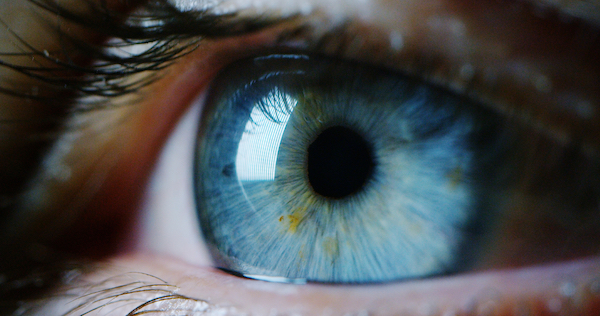
Image via Shutterstock
Cancer patients have reported a heightened ability to see in the dark after being on photodynamic therapy, a type of treatment that targets the tumor by focusing a laser beam on it, which kills cancer cells.
For some time, scientists were baffled as to why patients experienced this bizarre side effect. They finally got their answer last year, according to ScienceAlert, citing the French National Center for Scientific Research (CNRS). In the human retina, there’s a light-sensitive protein called rhodopsin, and it interacts with chlorin e6, a core, photosensitive component in the treatment.
The discovery expands upon what scientists have known about retinal, an organic compound found in the eye. Although retinal isn’t sensitive to infrared light, with the introduction of both a chlorin injection and infrared light, retinal separates from rhodopsin and triggers the electrical signal in the brain that is known as sight.
“This explains the increase in night-time visual acuity,” said Antonio Monari of the University of Lorraine in France.
The observed combination was tested in a molecular simulation for several months, and spanned millions of high-level calculations.
With an understanding of how the night vision was triggered, scientists can now adapt treatments to eliminate this side effect. Although being able to see better in the dark has its perks, some of the patients reported seeing silhouettes in the dark.
Another boon is its implications in treating vision-related conditions, like certain kinds of blindness or over-sensitivity to light.
[via ScienceAlert, cover image via Shutterstock]
Also check out these recent news


