
NASA Tracks Explorers’ Journey In Antarctica To Assess Survival On Mars
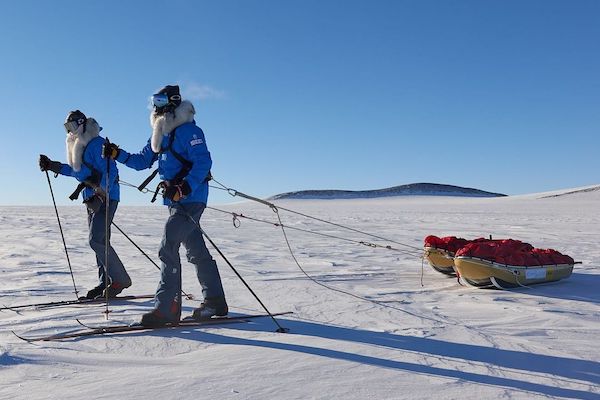
Image via Justin Packshaw
NASA is currently tracking the journey of two explorers as they travel 2,268 miles across Antarctica in a bid to learn more about humans’ ability to survive on Mars.
The two explorers, Justin Packshaw and Jamie Facer Childs, who hail from the UK, are nearing the mid-point of their 80-day trek through the world’s southernmost continent.
It is part of the Chasing the Light Mission, an arduous expedition that will allow the agency to study the psychological and physical impact of harsh conditions on the their mind and body.
According to Live Science, such conditions include the men withstanding freezing temperatures, with katabatibc winds going at a maximum of 200 mph. They will first make their way over 1,342 miles from the port of Novolazarevskaya to the geographic South Pole, before traveling 926 miles to Union Glacier Camp, the only occupied facility on Antarctica.
“Much like the extreme conditions found on planets in our solar system, Antarctica has a [harsh] environment that is useful for a range of human and biological research,” said the mission’s website.
“Justin and Jamie’s mission will allow scientists to observe a rare scientific story of human adaptability, which will ultimately contribute to … human centered space exploration.”
Throughout the mission, data from the trekkers’ wearable devices will be collected by the NASA, the European Space Agency (ESA), and Stanford University. They will travel via a mix of walking and skiing, sometimes using kites to pull themselves along with the wind.
Other than that, they are using no mechanical assistance, including towing two 440-pound sleds that store their supplies, equipment, and samples of blood, saliva, urine, and feces from across the trip.
Additionally, the two men will help scientists obtain environmental data, such as ice levels, radiation, and wind speed. This is because satellites currently do not orbit above the South Pole, and the information collected will fill in a “satellite data gap” and provide further insights for research purposes.
“This continent demands respect and also flexibility as you can rest assured that nothing will go according to plan and you can only hope that you can adapt accordingly and make that decision at the right time,” Packshaw wrote in his day journal.
“Which is what we feel we are doing with this call. Onwards…”
[via Live Science, cover image via Justin Packshaw]
Also check out these recent news


