
NASA Probe ‘Touches The Sun,’ Entering Solar Atmosphere For First Time Ever
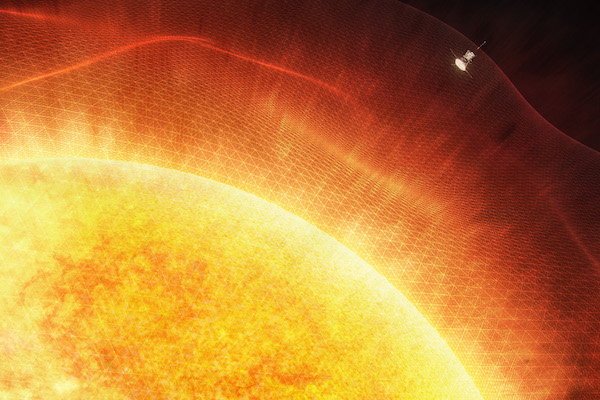
Image via NASA
For the first time in history, a spacecraft “touched the Sun” as the NASA Parker Space Probe traveled through the upper solar atmosphere in a historic trip to our nearest star.
Parker first embarked on its long-term mission in October 2018, and makes use of Venus’ gravity to steer its orbit around and through the Sun. According to CNN, the probe—which is about the size of a small car—will take 21 trips through the Sun’s corona over seven years.
Due to the uneven surface of the corona, on this milestone trip, Parker probe zig-zagged in and out of the Sun’s upper atmosphere several times across the span of a few hours. The probe even flew deep enough to encounter “pseudostreamers,” which are large structures visible from Earth during solar eclipses. Researchers noted that while it was within the superstreamers, Parker was enveloped in a bubble of calm, much like “flying into the eye of a storm.”
“We see evidence of being in the corona in magnetic field data, solar wind data, and visually in images. We can actually see the spacecraft flying through coronal structures that can be observed during a total solar eclipse,” said Nour Raouafi, the Parker Project Scientist at the Johns Hopkins Applied Physics Laboratory.
Justin Kasper, the lead author of the mission’s paper, said that the team was “fully expecting that, sooner or later, we would encounter the corona for at least a short duration of time,” and that it was “very exciting that we’ve already reached it.”
During the flight, the probe experienced temperatures of nearly 2,500°F but did not burn up due to it being protected by a carbon heat shield that was 4.5 inches thick. According to Interesting Engineering, the corona itself is hotter than the surface of the sun, with scientists estimating it could reach temperatures of up to 1.8 million degrees Fahrenheit at its hottest, while the surface is just over 10,000°F.
“Not only does this milestone provide us with deeper insights into our Sun’s evolution and its impacts on our solar system, but everything we learn about our own star also teaches us more about stars in the rest of the universe,” said Thomas Zurbuchen, associate administrator for the Science Mission Directorate at NASA.
[via Interesting Engineering, cover image via NASA]
Also check out these recent news


