
Impeccably-Preserved Mammoth Graveyard Recovered Near Busy England Road
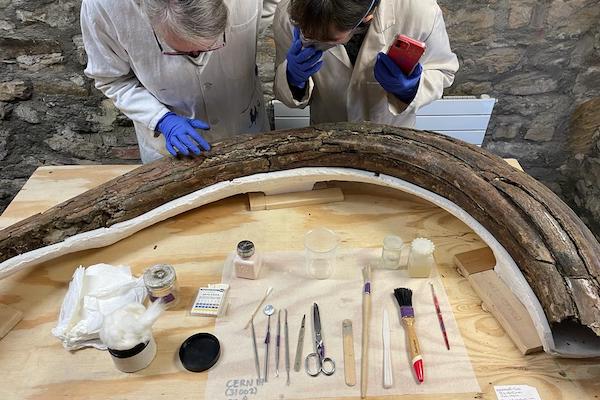
Image via DigVentures
Although the mammoth was a creature that went extinct thousands of years ago, it’s a creature that has captured our fascination with its mere existence—to the point that scientists are (still) trying to recreate it.
So when a “graveyard” of Ice-Age animals, including the mysterious-yet-revered mammoth, was discovered in a quarry near Swindon, England, excitement abounded.
It started when a duo of private fossil hunters, who were originally set out to find some marine fossils, stumbled across the mammoth bones and a Neanderthal hand ax instead.
A few excavations later, “at least” five of these creatures were recovered—including two adults, two juveniles, and an infant. These remains, such as tusks, leg bones, and vertebrae, were attributed to the Steppe mammoth, a smaller and less hairy species than the Woolly mammoth.
Alongside these, remains of other creatures like steppe bison, cave bears, and gigantic elks were also dug up.
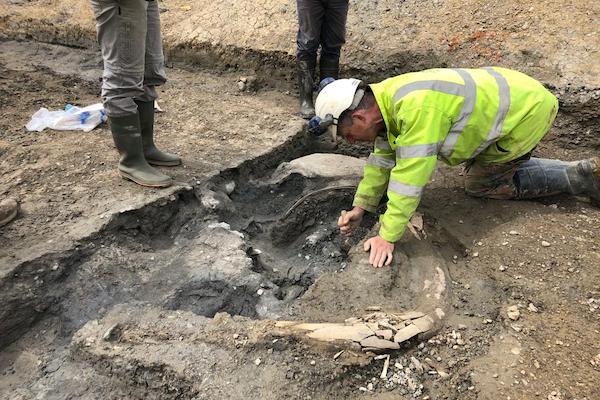
Image via DigVentures
Gizmodo reports that all of these were retrieved just 16 feet below ground level, with close proximity to a busy road.
The excavations, led by archeological organization DigVentures, also revealed “well-preserved evidence” including incredibly delicate beetle wings and snail shells, as well as stone tools belonging to the Neanderthals.
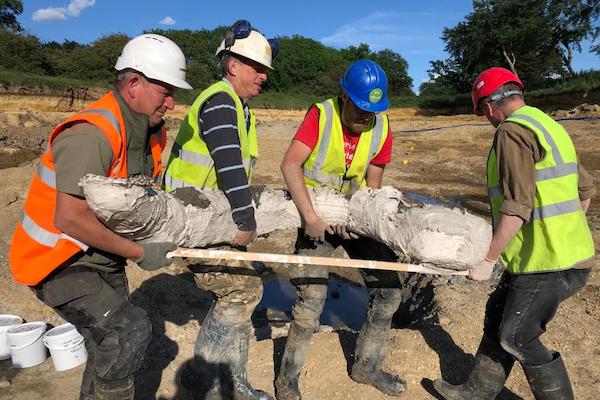
Image via DigVentures
“Finding mammoth bones is always extraordinary, but finding ones that are so old and well-preserved, and in such close proximity to Neanderthal stone tools, is exceptional,” shares Lisa Westcott Wilkins, co-founder of DigVentures, in a statement.
“Words can’t quite capture the thrill of seeing a mammoth tusk still in the ground, or the feeling of standing in the middle of a site that has the potential to change how we see our closest human relatives and the Ice Age megafauna they shared their world with.”

Image via DigVentures
The mammoth bones are currently being studied at the Natural History Museum, London. The “unusually high preservation” of the site and its findings will also take center stage in an upcoming BBC documentary featuring David Attenborough alongside members of DigVentures.
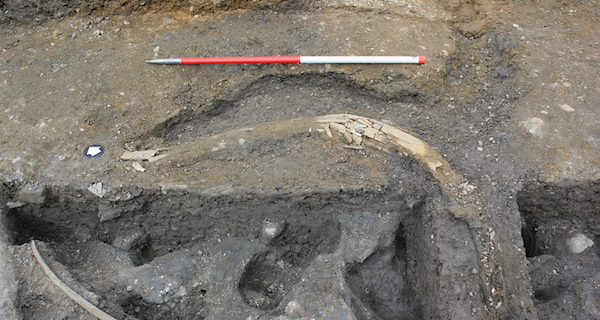
Image via DigVentures
[via Gizmodo, images via DigVentures]


