
SpaceX To Send Human Muscle Cells To Space To Uncover The Secrets Of Aging
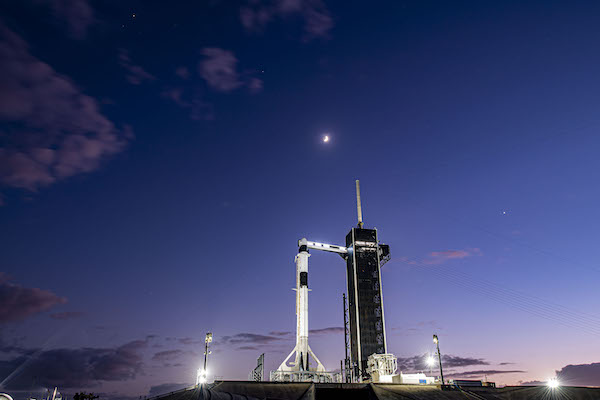
Image via SpaceX
Next week, a SpaceX launch will carry samples of a rather special study that aims to better understand the reasons human age.
Named MicroAge, the study by UK researchers from the University of Liverpool will see the rocket blast off with laboratory-grown muscle cells, in an attempt to uncover why muscles weaken with age, and how we could possibly slow down the aging process here on Earth.
As with other SpaceX launches, this spacecraft will take off from the Kennedy Space Center in Florida, and will hook up to the International Space Station (ISS) once it’s in orbit. The cells, which are said to be the size of a grain of rice, will undergo various experiments in microgravity aboard the station.
The tests include some of the cells being electrically stimulated to “exercise,” while the others will be exposed to higher levels of protective heat shock proteins, which the scientists believe could protect against age-related muscle degradation.
In order to send the study into space, the team had to shrink the electronic equipment needed from one that filled a large desk to just the size of a pack of playing cards.
“This development work on automated and miniaturized systems represents an exciting innovation that could have wider application in the future,” said Professor Malcolm Jackson, also from the University of Liverpool.
According to Euronews, the tests are being carried out in space as the lack of gravity leads to astronauts suffering from muscle weakness and loss of muscle mass.
“Astronauts in microgravity lose their muscle mass and strength at an accelerated rate compared with older people on Earth, providing a unique model to rapidly determine the mechanisms underlying muscle loss not only in astronauts, but with relevance to older people,” explained Professor Anne McArdle, from the University of Liverpool’s Institute of Life Course and Medical Sciences.
Team @MicroAgeUoL have completed handover of our muscle constructs to NASA after a gruelling and eventful 12 hour integration day. Excited for the launch on Tuesday 🚀🤞. Sam, Kay and Shah were awesome. Watch this space! @LivuniILCaMS @LivUni @spacegovuk @livunieng @livuniHLS pic.twitter.com/sNvo1NNIK8
— MicroAge UoL (@MicroAgeUoL) December 20, 2021
[via Euronews, cover image via SpaceX]
Also check out these recent news


