
New EV Charger Taps Into Excess Renewable Energy, Deploys Sans Breaking Ground

With an oncoming influx of EVs, there is bound to be a similar flurry of chargers to follow. Up until now, these have mostly come in the form of a roadside station, or a plug integrated into the wall of a house.
But that begs the question: what will happen to those who live in apartments, can’t install one in their house, or can’t rely on a public charger?
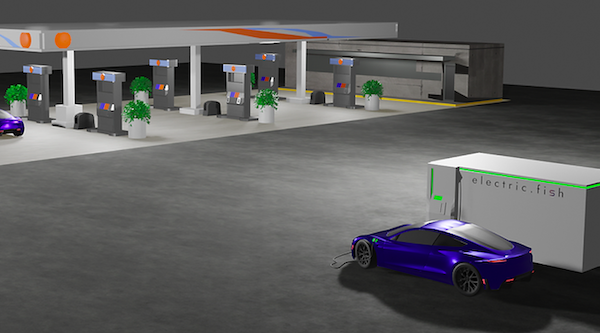
ElectricFish may have the answer, it appears. This startup is aiming to find a new way of powering our new vehicles instead of relying—or further burdening—our existing grid. And as it turns out, the answer was staring us in the face all along: another huge battery, named 350².
350² is “a plug and play energy storage system designed to power community loads through a bi-directional electricity meter, and an ultrafast charging CCS port that can deliver extreme-fast charging rates to vehicle architectures from 300 - 950 VDC,” its product website claims.
“We can store that energy and then detach the EV charging load from the grid itself,” Anurag Kamal, the firm’s CEO, tells Fast Company.
This battery, or energy storage unit, works almost similarly to its Supercharger-type counterparts, but it takes advantage of excess production of renewable energy.
For example, in California, it was reported that due to the state’s sunny disposition, it’s now having a surplus of solar energy. By storing this, the chargers can not only fuel the EVs but also act as a backup if the grid fails.
Adding to the convenience of it all is the portability of the 350², since it doesn’t require trenching to install. Apart from being easier to deploy, it’s also cheaper.
“That process of digging up the ground, and getting the permitting for that, can take a year because of all the engineering work that is required on the utility side to actually prepare the site for that level of charging,” explains Vince Wong, chief operating officer at ElectricFish. According to him, when it comes to the 350², that process is reduced to just “a couple of months” instead.
It’s not just great news for EV owners, but for gas stations, too. Co-founder Folasade Ayoola explains to Fast Company how around 70% of gas stations in the US are individually owned, and the switch to EVs will start to hinder small businesses.
A few of the 350² units can be placed at gas station parking lots, and cars will be able to get around 100 miles of range added in just 10 minutes. It’s convenient, familiar to those reluctant to make the electrification switch, and will keep the gas stations afloat.
The limit is 10 minutes because “it’s very similar to behavior at a convenience store—people only spend 7 to 10 minutes there,” Kamal muses. “And if you come, and the charger is being utilized, you know that at the end of 10 minutes, it will be available for you. So that’s very central in trying to make people believe that EV charging is just like gasoline.”
[via Fast Company, images via ElectricFish]


