
Goldfish Successfully Learn To Drive On Land Via ‘Fish-Operated Vehicle’
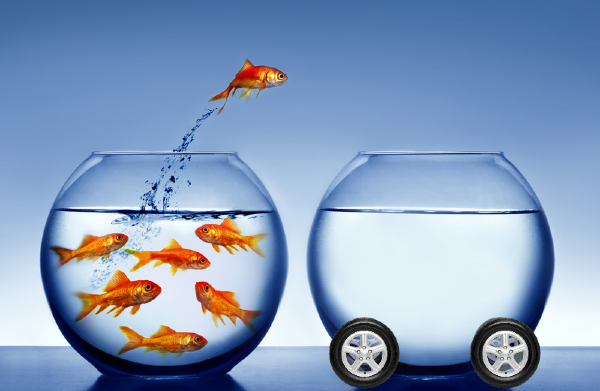
SpongeBob SquarePants’ Bikini Bottom might be closer than you think. Scientists at Ben-Gurion University of the Negev in Beersheba, Israel, taught goldfish to drive in what is termed a “fish-operated vehicle” (FOV)—on land.
The goal wasn’t to acclimate them into joining the Uber workforce, but to see if the navigational skills of fish are universal and can be used in completely unfamiliar environments, potentially affirming something called a domain transfer methodology.
In other words, the researchers wanted to know if—when the gilled participants were moved into unknown terrain—they would react like fish out of water, as the saying goes.
The FOV was a camera-connected fish tank on wheels, with the lens being used to track the driver’s position. The vehicle would move according to which wall the fish was closer to.
There were one-on-one driving lessons, of course. Each of the six participating goldfish was taught to maneuver the FOV in 30-minute sessions that took place thrice a week. The students were rewarded whenever they reached their destination, a pink corrugated board.
Not only did they learn to reach their target, but they also picked up speed to get there and even figured out how to avoid dead ends. To make sure the fish weren’t just memorizing their paths (turns out, the goldfish memory is a myth), the scientists threw in fake targets and moved their starting positions. They still thrived.
A now-viral video shared by Ronen Segev, one of the study’s authors, demonstrates how adept the fish have become with driving on land. The research was recently published in the Behavioral Brain Research journal, and is peer-reviewed.
I am excited to share a new study led by Shachar Givon & @MatanSamina w/ Ohad Ben Shahar: Goldfish can learn to navigate a small robotic vehicle on land. We trained goldfish to drive a wheeled platform that reacts to the fish’s movement (https://t.co/ZR59Hu9sib). pic.twitter.com/J5BkuGlZ34
— Ronen Segev (@ronen_segev) January 3, 2022
The authors concluded that how fish perceive space and the methods they use to get from place to place “may be as successful in a terrestrial environment as they are in an aquatic one.”
The experiments prove that, even if they haven’t evolved to work around land, fish can still navigate it well. Plus, the positive results hint that mammals and birds—which have similar brain structures in the lobe overseeing learning and memory—might be able to pick up driving skills too.
[via Ars Technica and Motherboard, images via various sources]


