
Ancient Roman Tomb Reveals Secrets Of Why 2,000-Year-Old Concrete Is So Durable
It has been almost 2000 years since the Roman Empire fell, but some of its structures still stand today. This incredible structural resilience has withstood more than just the test of time; it has also survived changes in climate, modernization, and even war.
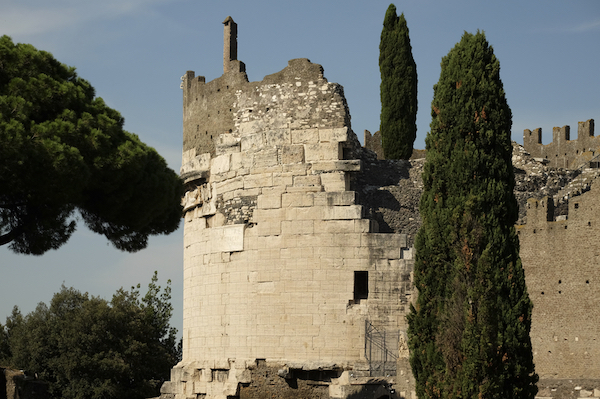
One such remaining monument of the times is the Tomb of Caecilia Metella, a noblewoman who lived in the first century CE. Despite being around 2,050 years old, the remains of the structure still stand majestically three miles outside Rome.
How did it manage to survive the ravages of our changing world? Investigations by scientists from the University of Utah revealed that a combination of volcanic aggregate, rain, and groundwater might have had a part to play.
In a paper published in the Journal of the American Ceramic Society, researchers write that the quality of the concrete of her tomb might’ve been even better than the tomb of Metella’s male counterparts thanks to the chemical reactions between those three components.
“The construction of this very innovative and robust monument and landmark on the Via Appia Antica indicates that she was held in high respect,” Marie Jackson, research associate professor of geology and geophysics at the University of Utah, shares in a statement.
Jackson visited the monument in 2006 to collect samples of the mortar for analysis. “It was a very warm day in June,” she recalls, “yet when we descended the steps to the sepulchral corridor the air became very cool and moist.”
“The atmosphere was very tranquil, except for the fluttering of pigeons in the open center of the circular structure.”
Ars Technica reports that Roman concrete was similar to the Portland cement of today. The Romans mixed a semi-liquid mortar with stones or bricks of aggregate to form the material.
This mortar was made from hydrated lime and porous glass and crystals from volcanic eruptions, also known as volcanic tephra.
After analysis of the samples, Jackson and a team of MIT colleagues discovered that the tomb’s mortar comprised volcanic tephra, binding large chunks of brick and lava aggregate. This tephra contained a large amount of potassium-rich leucite.
Rainfall and groundwater over many centuries began to seep through the tomb’s walls, which dissolved the leucite, releasing the potassium. In today’s concrete, this would’ve meant that the structure was more likely to succumb to cracking and deterioration.
But the opposite happened with the tomb. Jackson and the team found that the potassium had changed the calcium-aluminum-silicate-hydrate (C-A-S-H) binding phase, the “glue” of the mortar.
“We saw C-A-S-H domains that were intact after 2,050 years and some that were splitting, wispy or otherwise different in morphology,” Jackson says. The wispy domains appeared to take on a “nano-crystalline nature.” These “evidently create robust components of cohesion in the concrete,” she continues.
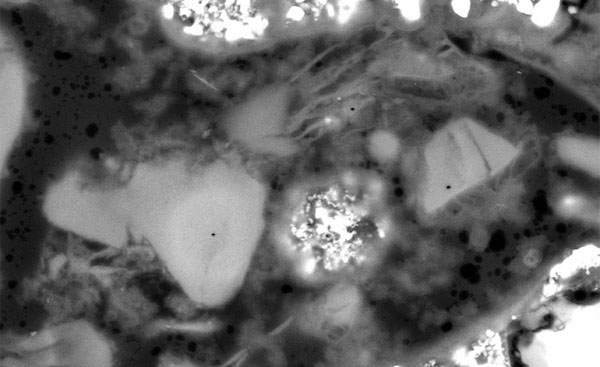
Admir Masic, associate professor of civil and environmental engineering at MIT, reiterates that in concrete, the interface between aggregates and mortar of any concrete is “fundamental” to how long the structure can last.
“It turns out that the interfacial zones in the ancient Roman concrete of the tomb of Caecilia Metella are constantly evolving through long-term remodeling,” he details. “These remodeling processes reinforce interfacial zones and potentially contribute to improved mechanical performance and resistance to failure of the ancient material.”
By learning about the way the ancient Romans built their concrete, we’re able to get closer to being able to replicate these properties today. Apart from longer-lasting structures, this method of creating concrete may have the potential to reduce emissions by up to 85%, per Ars Technica.
[via Ars Technica and the University of Utah, images via the University of Utah and ID 128249390 © Claudio Balducelli | Dreamstime.com]


