
China’s ‘Artificial Sun’ Is Now Five Times Hotter Than The Sun
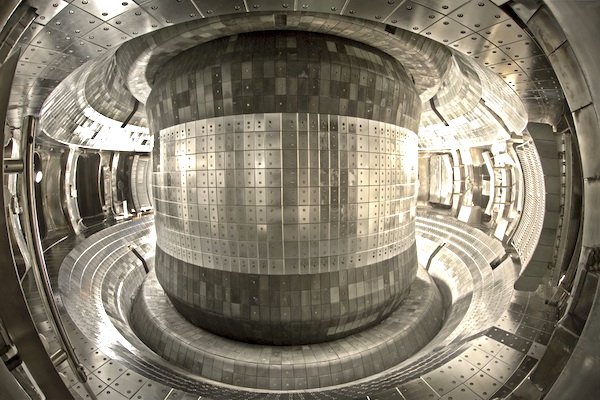
China’s “artificial sun,” named the Experimental Advanced Superconducting Tokamak (EAST) nuclear fusion reactor, has reportedly broken the world record after it managed to heat plasma at a temperature five times hotter than the sun for over 17 minutes.
According to the Xinhua News Agency, the reactor held a temperature of 158 million degrees Fahrenheit for a total of 1,056 seconds. This feat surpassed the previous record set in 2003 by France’s Tore Supra tokamak, which heated plasma at similar temperatures for 390 seconds.
In fact, the EAST had set another record of its own in May last year, reaching a staggering 216 million degrees Fahrenheit for over 100 seconds. The temperature of the core of the actual sun only reaches about 27 million degrees Fahrenheit, as per Live Science.
“The recent operation lays a solid scientific and experimental foundation towards the running of a fusion reactor,” said experiment leader Gong Xianzu, a researcher at the Institute of Plasma Physics in the Chinese Academy of Sciences.
This record could signal a breakthrough in nuclear fusion is imminent, which scientists have been trying to harness for over 70 years. The aim is to be able to generate energy to power the plant without greenhouse emissions or radioactive waste, though this world-changing endeavor isn’t so simple.
As reported by Science Alert, researchers would have to successfully replicate a process that takes place organically in the heart of a star, using high temperatures and pressure to “squeeze” atomic nuclei together that they form new elements.
In most of the stars in our galaxy, the nuclei are hydrogen, which then merges together to form helium. And because one helium nucleus takes up much less space than the four hydrogen nuclei that fuse together, the excess mass is generated as an enormous amount of heat and light energy.
However, since the invention of the first tokamak in 1958, no team has successfully created a fusion reactor that can generate more energy than it takes in. Not to mention, handling plasma at temperatures many times hotter than that of the sun is no mean feat.
Going forward, EAST will continue testing technologies in anticipation of an even larger fusion reactor being built in Marseille, France—the International Thermonuclear Experiment Reactor (ITER).
The ITER is a collaboration project between 35 countries, including the European Union, UK, US, China, and India. Soon to be home to the world’s most powerful magnet, scientists hope they’ll be able to finally succeed at harnessing star power when it comes online in 2025.
[via Live Science and Science Alert, cover image via Institute of Plasma Physics Chinese Academy of Sciences]


