
Doctors Transplant Genetically-Modified Pig’s Heart In Human In Medical-First
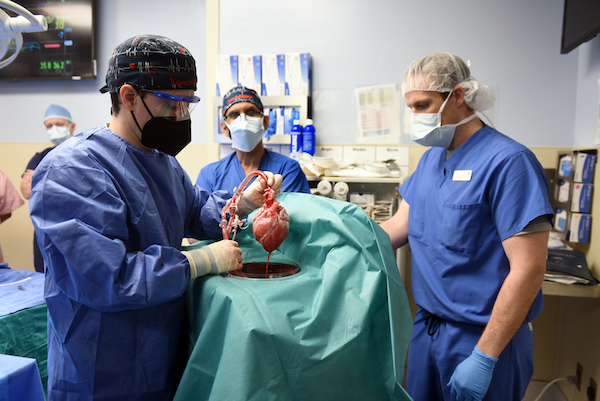
A man lives after doctors implanted a pig heart into his body, the only option left to save his life. This was an extremely risky undertaking as it would mark the first successful attempt to insert a genetically modified pig heart into a human without the organ being automatically rejected.
57-year-old David Bennett had terminal heart disease and was ineligible for the usual heart transplant or an artificial heart pump, according to CNN. Running out of options, doctors at the University of Maryland Medical Center presented him with an unusual proposition: xenotransplantation—the transplantation of cells, tissues, or organs from a non-human source.
“It was either die or do this transplant,” Bennett addressed in a statement a day before the procedure. “I want to live. I know it’s a shot in the dark, but it’s my last choice.”
The surgery was authorized by the Food and Drug Administration as a “compassionate-use” emergency situation. Last Friday, surgeons performed the first-of-a-kind operation last Friday, and it was completed in seven hours.
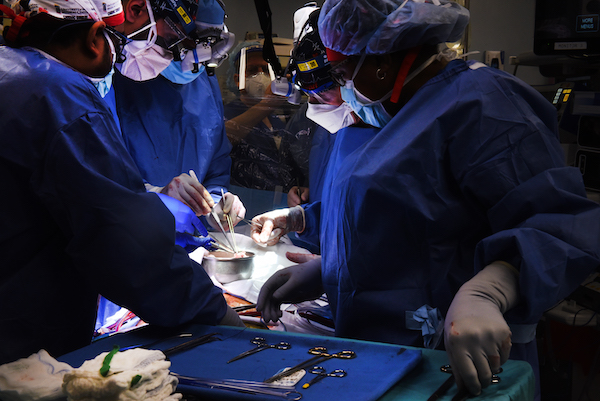
As of Monday, three days after the transplant, the patient has been reported to be doing well.
As a medical-first, though, this situation might change at any time. Doctors will now spend the coming days or weeks monitoring Bennett’s condition for complications.
If proven successful, the implications for this sort of xenotransplantation would be immense. At present, human organs for transplants are in shortage, but the possibility of using genetically modified animal organs will offer “an endless supply” of options, describes Dr Muhammad Mohiuddin, scientific director of the animal-to-human transplant program in the university, in a statement published by the Associated Press.
For now, the surgery gives validation that the heart of a genetically modified animal can be transplanted in a human without it being immediately rejected. It comes after a pig-to-human kidney transplant that saw the organ being attached to the outside of a human body in October 2021.
It is worth noting that the procedure has seen positive results thus far because the animal was gene-edited to have a heart absent of a sugar that has previously caused rapid organ rejections, though it’s still too early to know if it is a success.
Nevertheless, the project’s leader Dr Robert Montgomery of NYU Langone Health calls this experimental surgery “a truly remarkable breakthrough.”
“As a heart transplant recipient, myself with a genetic heart disorder, I am thrilled by this news and the hope it gives to my family and other patients who will eventually be saved by this breakthrough,” notes Dr Montgomery.
Mohan Suntha, MD, MBA, president of University of Maryland Medical System, concludes: “We appreciate the tremendous courage of this live recipient, who has made an extraordinary decision to participate in this groundbreaking procedure to not only potentially extend his own life, but also for the future benefit of others.”
[via NPR and CNN, images via University of Maryland School of Medicine]


