
33-Foot Jurassic Sea Dragon Accidentally Uncovered In England Nature Reserve

Britain’s largest fossilized ichthyosaur, otherwise nicknamed the Rutland Sea Dragon, was discovered in the country’s smallest county almost a year ago.
The stunning find took place at the Rutland Water Nature Reserve, located in Oakham, England. Like many other serendipitous discoveries, the fossil was stumbled upon when preparing the area for re-landscaping and other works.
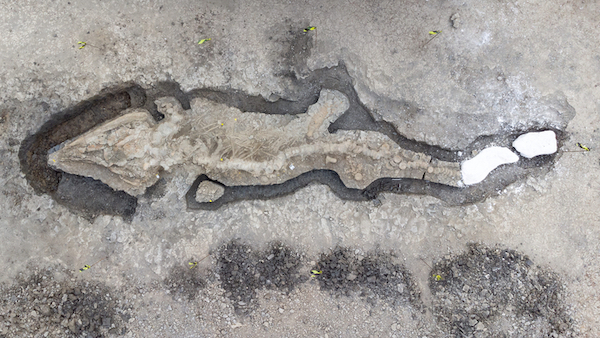
Rutland Water Conservation team leader Joe Davis recalls to the BBC when he and Reserves Officer Paul Trevor saw “what seemed like stones or ridges in the mud,” except they looked more “organic” than that.
"Then we saw something that looked almost like a jawbone… I rang up the county council and I said, ‘I think I’ve found a dinosaur.’”
Their response was, “We don’t have a dinosaur department at Rutland County Council so we’re going to have to get someone to call you back.”
But after a team of paleontologists were consulted for a closer look, it was confirmed that the duo hadn’t come across a dinosaur: it was an ichthyosaur instead.
This marine reptile group went extinct around 90 million years ago. Although their shape is similar to dolphins, they could measure more than 25 meters (82 feet) in length.
According to Nerdist, they were “carnivorous ocean hunters” with a penchant for fish and squid, and often were found in shallow ocean waters.

A press release by the Leicestershire and Rutland Wildlife Trust details that this creature, with a 10-meter (32.8-foot) skeleton, dates back approximately 180 million years. Its skull alone weighs one ton—just over 2200 pounds.
It was excavated fully between August and September 2021to reveal almost a complete skeleton—the largest and most complete of its kind, at that.
This particular specimen is still the subject of research, and there is a considerable effort going towards preserving the remains to the best of the team’s ability. The discovery was also featured in the recent episode of the BBC Two show Digging For Britain.
[via Nerdist and the Stratford Observer, images via the Leicestershire and Rutland Wildlife Trust]


