
English City Makes Sustainable Bee Bricks A Requirement For New Architecture
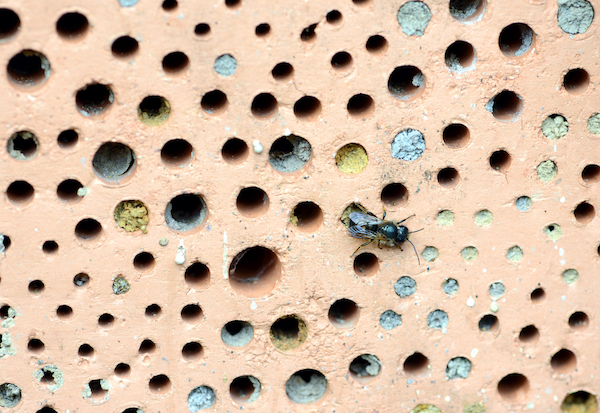
The population in Brighton and Hove is about to grow substantially, though residents need not worry about overcrowding. The city in East Sussex, England, has passed a planning law to mandate bee bricks and swift nesting boxes for all new buildings taller than five meters (16.4 feet).
That’s right; sightings of the birds and the bees in action will become more frequent here, though not in the way you might think. New architecture should include at least three bird boxes and one beehive brick, which is the same size as typical bricks but differs in its inclusions which welcome solitary bees to live in them.
The idea was first proposed by Brighton and Hove councilor Robert Nemeth in 2019, and was repeatedly brought up in requests from April 1. 2020.
A bee brick - now compulsory in Brighton & Hove on new buildings after I raised issue at Council. Big victory. pic.twitter.com/felFEB5FEH
— Cllr Robert Nemeth (@robert_nemeth) January 11, 2022
The Guardian reports that solitary bees make up the majority of bees in Britain—comprising almost 250 of 270 species. With this project, hermit bees whose natural homes have been threatened would finally have a place to nest.
“Bee bricks are just one of quite a number of measures that really should be in place to address biodiversity concerns that have arisen through years of neglect of the natural environment,” details Nemeth, via Dezeen.
Unlike “insect hotels,” which are normally crafted from wood, bee bricks are usually concrete and are thus less likely to rot or be infested with pests like mites. Plus, Lars Chittka—a professor in sensory and behavioral ecology at Queen Mary University—told the Guardian that bees “naturally possess hygienic behavior” that helps keep the holes clean. They’d also assess the bricks before using them.
The feasibility of bee bricks is still up for debate, however. Dave Goulson, who teaches biology at the University of Sussex, said some of the holes in them aren’t deep enough, which could turn the material into a “greenwashing” tool rather than benefit the population. “Far more substantial action is needed,” he said. Nevertheless, Goulson noted that these are “probably better than nothing.”
Nemeth acknowledges that more can be done, but requiring bee bricks in buildings is just one way to increase biodiversity in the city. “As time goes by and awareness is raised, these sorts of niggles will invariably be ironed out,” said the councilor, who is also a property developer and professional beekeeper. “I’ve seen many great examples of solitary bees using the bricks and am won over to their potential.”
[via Dezeen, Time Out, The Guardian, images via various sources]


