
First-Of-Its-Kind Space Plane Lifts Off Horizontally, Can Also Be Used On Earth

An artist’s concept of ‘Radian One’ flying over Earth. Image via Radian Aerospace / PR Newswire
Unlike existing spacecraft, this interstellar plane launches horizontally from the ground and lands on the runway in the same manner, just like an airplane.
Why is something like this in the works, you may ask? Most notably, the typical spacecraft cannot lift off on its own—it would be attached to an energy-heavy rocket booster, which helps propel it into orbit before letting go and falling back into Earth. This vertical journey is known as a two-stage launch.
The solution by Washington-based Radian Aerospace, however, will enable a single-stage process—the first of its kind for space planes, say its co-founders, who come from prominent space organizations like Boeing, NASA, and the US Department of Defense. Dubbed the ‘Radian One’, the plane eliminates the need for heavyweight boosters, ultimately driving down costs and energy consumption.
Radian One is the “world’s first fully reusable horizontal takeoff and landing, single-stage to orbit spaceplane” and is being designed to further opportunities for research, observation, and exploration in space, as well as in-space manufacturing.
“We are not focused on tourism,” remarks Radian’s CEO and co-founder Richard Humphrey in a press release, separating the startup’s goals from the commercial vision of firms like Elon Musk’s SpaceX and Jeff Bezos’ Blue Origin. Instead, the company is doubling down on the hope that “widespread access to space means limitless opportunities for humankind.”
“Over time, we intend to make space travel [for research] nearly as simple and convenient as airliner travel,” Humphrey adds.
The startup, whose advisory board members consist of former International Space Station and Space Shuttle commanders, announced on January 19 that it has been released from “stealth mode” and has secured US$27.5 million in funding to build Radian One.
If successful, Radian One will go where space planes of NASA, Boeing, and the Soviet Buran haven’t. Existing models can only take off vertically while being boosted by rockets, though they can also land horizontally.
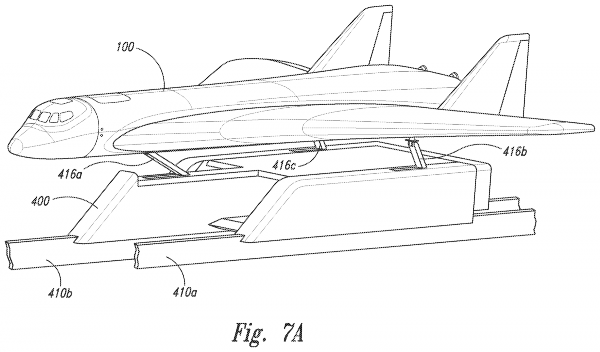
Image via Radian Aerospace / Google Patents
It receives its boost from a rocket-powered sled tucked underneath, which would get the plane running on the runway before detaching. This means Radian One would be more lightweight than the usual spacecraft and wouldn’t need the fuel required to sustain a booster in flight.
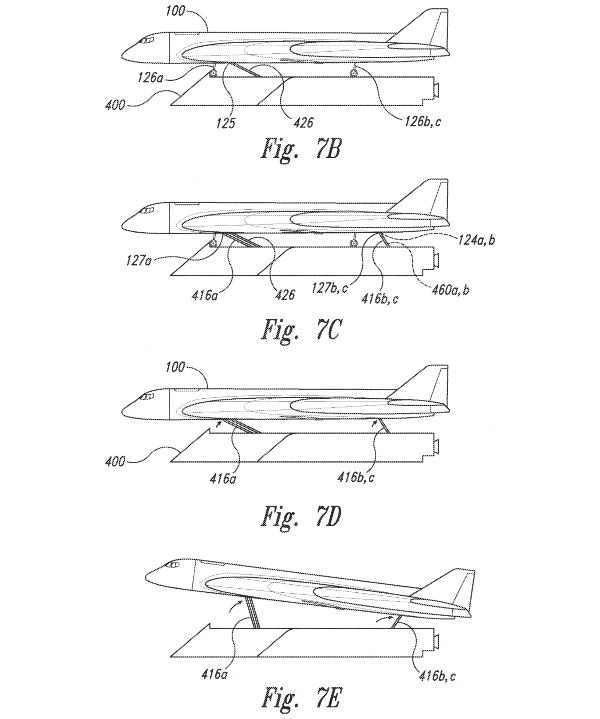
Image via Radian Aerospace / Google Patents
At landing, Radian One could share space with commercial airliners on runways, instead of descending on landing pads or splashing into the ocean. It can then be flown again in the next 48 hours.
It would be able to carry five people, as well as transport cargo of up to 5,000 pounds on Earth in under an hour when it’s not on a space mission—therefore serving purposes at home and on other planets.
Doug Greenlaw, who invested in Radian, says the idea is the “‘holy grail’ of accessing space with full reusability and responsiveness to provide customers unmatched cost effectiveness and flexibility.”
A full-size prototype has already been developed and is already being tested, Humphrey tells Ars Technica. “We’re still in the leading edges of that work,” he elaborates. “We understand the fundamentals, we can start it, we can stop it, and we’re taking a series of small, progressive steps to get to a full capability.”
Radian plans to build a fully-functioning Radian One by 2030.


