
‘Invisible’ 3D-Printed Labels Could Replace Barcodes To Be Less Of An Eyesore
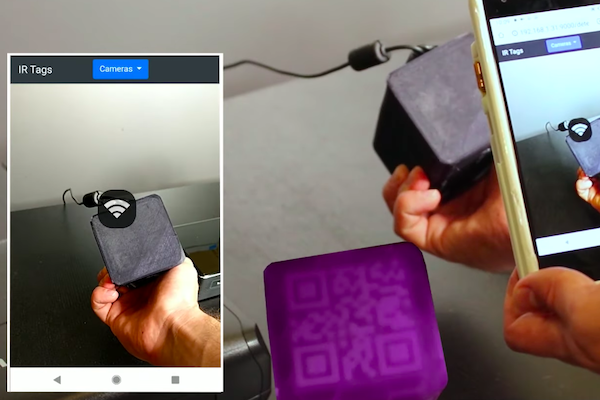
It’s not often that we think “infrared” and follow up with, “ah, yes, barcodes,” but that train of thought might become a common one if this invention finds its way into the mainstream.
InfraredTags, a technology developed by MIT PhD student Mustafa Doga Dogan, aims to use 3D printing to embed small codes of information onto existing products that sit right there. Importantly, these codes can’t be seen unless scanned with an infrared camera.
The beauty of infrared cameras is their ability to pick up on things that are otherwise invisible to the naked human eye, as they can see through materials that are opaque in visible light.
Unlike barcode stickers, these invisible tags don’t interfere with the product, won’t get destroyed over time, and certainly won’t leave that nasty residue when attempting to peel it off.
A 3D-printed plastic filament is key to this process, which can be tackled in two ways, as reported by New Atlas.
One is through engraving what are essentially ones and zeros in the form of tiny air gaps out of a layer of plastic, which is then protected with a smooth outer layer. The endproduct can be read by the camera as binary code.
Another way involves a second plastic to create barcodes or QR codes. This material would be opaque to infrared light but is still covered with an outer layer of the main plastic, remaining mostly invisible.
“InfraredTags is a really clever, useful, and accessible approach to embedding information into objects,” states Fraser Anderson, a senior principal research scientist at the Autodesk Technology Center.
“I can easily imagine a future where you can point a standard camera at any object and it would give you information about that object—where it was manufactured, the materials used, or repair instructions—and you wouldn't even have to search for a barcode.”
Some of the objects tested out by Dogan and his team include a mug with a barcode engraved in its walls, a Wi-Fi router with network name and password stored in tags, and even a video game controller.
[via Tech Xplore and MIT, images via MIT CSAIL]


