
Grocery Store Rethinks Receipts To Track CO2 Footprint, Changing Shopping Habits

A receipt is a record of items you’ve purchased and how much each costs. But that’s not the only thing that can be displayed on a receipt, as a new system pioneered by Oda, a Norwegian online grocery service, has discovered.
Alongside the price in kroners of each item, Oda’s receipts have also begun to show the carbon footprint each item has.
“Our customers told us that they find it close to impossible to know what is climate-friendly. We thought it was an important challenge to solve so we started looking for easy ways to communicate emissions,” Louise Fuchs, Oda’s sustainability director, explains to Yahoo! News.
However, the company wanted to avoid “pointing fingers” and telling customers “what to buy and what to avoid,” she clarifies. Instead, the CO2 emissions data just presents as an objective fact.
What the customer chooses to do with this information is still entirely up to them, but this has created some very promising results.
On top of the receipts, Oda also incorporated a customer-facing page providing information about emissions, which UX design manager Silja Mustaparta-Dolve describes as “a more powerful asset than you might think.”
“We lived well without it for years, but now that it exists, it is suddenly very hard to remove,” she reflects in a Medium article.
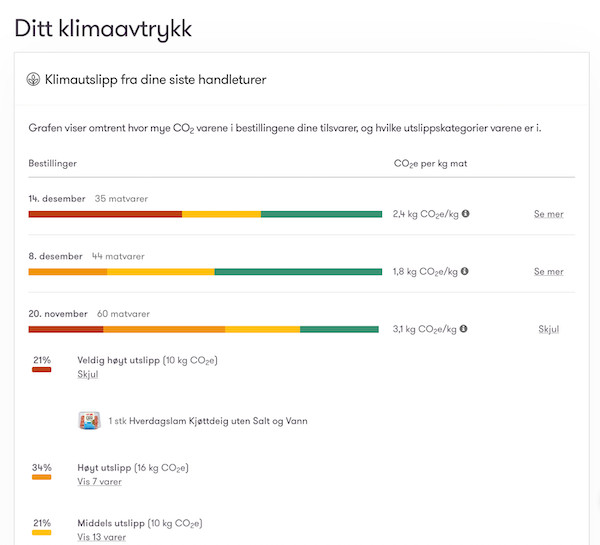
Oda collaborated with Cicero, a Norwegian climate research institute, to sort its products into high-, medium-, and low-emission categories. Examples of high-emission foods include things like red meat, while most fruit and vegetables remain at the bottom of the list. These are indicated on the receipts accordingly.
Happily, customers have begun to shift their shopping habits after realizing the impact their routine grocery trips have on the planet.
“Our customers buy more than 50% more fruit and veg than the average consumer and meat substitutes are growing 80 per cent year-on-year since we added the carbon receipts,” Fuchs states.
Additional data shows that one in every five burgers sold is a vegetarian one, and lentil soup has become one of Oda’s top 10 sold recipes despite never having even come close before.
[via Upworthy and Yahoo! News, images via Oda]


