
These 3D-Printed Soft Robots Are Recyclable—As They’re Made From Sugar & Gelatin
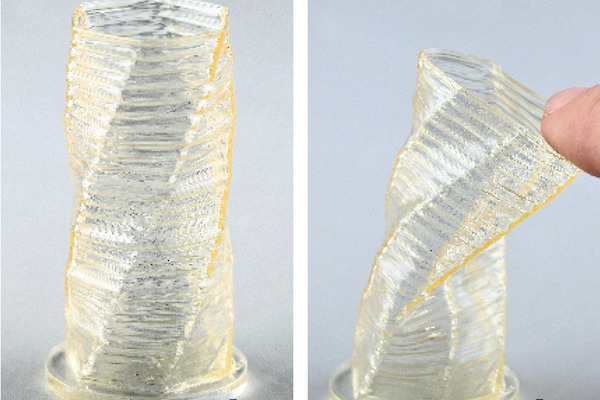
A team of researchers from the Johannes Kepler University, Austria, have reportedly created a new “gel” to 3D-print robots that, at their end of life, can be recycled.
These are “soft robots,” which are usually made from soft materials. Tech Xplore reports that these are mostly used to replicate water-borne creatures, allowing the robots to swim around as they would.
This does mean, however, that the materials they’re made from cannot afford to disintegrate even if submerged in water. In turn, it’s largely difficult to create biodegradable soft robots, and these end up contributing to the environmental footprint from waste.
According to the study published in the journal Science Robotics, the researchers state that tech waste can accumulate to up to 100,000 tons every day, per data from 2019.
In this new research, the team details using sugar and gelatin, two rather accessible and unsuspecting materials, to create an ink that can be used in printing. By warming it to the point of softness, the material can be used in a printer. Placing the setup in a cooled room will allow for the material to solidify quickly, retaining its printed shape.
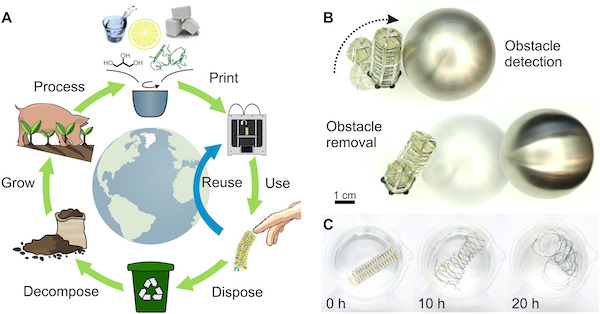
To test this, a finger-like form was successfully printed with the new ink. This is said to use compressed air to control motion, per Silicon Republic.
“This process enables fast and cost-effective prototyping of resilient, soft robotic applications from gels that stretch to six times their original length, as well as an accessible recycling procedure with zero waste,” the researchers write in their study.
This biogel can reportedly be reused by printing with it up to five times, meaning that damaged or obsolete bots can be reheated to retrieve the material.
And at the end of those five times, or if the robot needs to be sent somewhere that makes retrieval impossible, it can be done hazard-free at no cost to the environment.
[via Tech Xplore and Silicon Republic, images via A. Heiden et. al / Johannes Kepler University]


