
Scientists Create The ‘Most Accurate’ Virtual Model Of Our Universe Yet
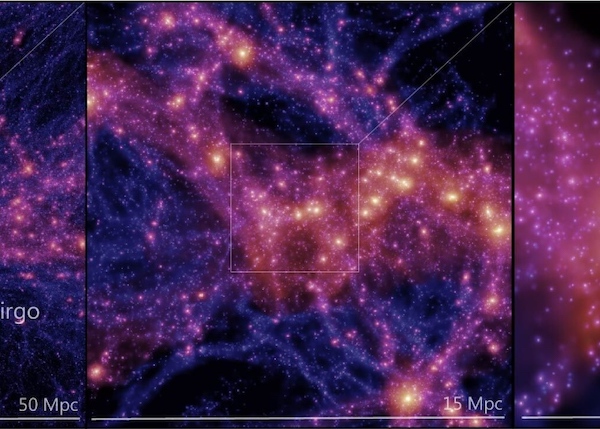
All the things scientists know about our patch of the universe have been mapped out in what is the “largest and most accurate computer simulation” of it yet.
Dubbed Sibelius-Dark, with “Sibelius” being the acronym for a Simulations Beyond the Local Universe project, the simulation comprises over 130 billion simulated particles spanning a distance of 600 million light-years from our speck of a planet.
It traces the evolution of the cosmos, from the Big Bang to the universe of today. The visualization took thousands of computers several weeks to produce, and amounts to over one petabyte of data, Bloomberg reports. The team behind the project, made up of scientists around the world, recently documented the research in an arXiv.org article.
Visible are recreations of the Virgo, Coma, and Perseus galaxies, our Milky Way, the Great Wall, and the Andromeda galaxy.
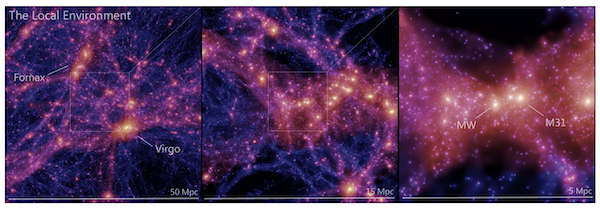
The visualization was performed on the DiRAC COSmology MAchine (Cosma) supercomputer in the possession of Durham University’s Institute for Computational Cosmology, one of the collaborators.
What the scientists uncovered from the simulation is that our section of the universe is pretty unusual, in that it contains fewer galaxies than the average patch of universe; this anomaly is attributed to an under-density of dark matter in the area. But it is only one of the countless discoveries we are about to make.
Dr Stuart McAlpine, a former Durham PhD student and now postdoctoral researcher at the University of Helsinki, describes: “By simulating our universe, as we see it, we are one step closer to understanding the nature of our cosmos.”
[via Cool Hunting and Bloomberg, images via Dr Stuart McAlpine]


