
Scientists Invent Woven Fabric That Turns Clothing Into Displays, Energy Sources
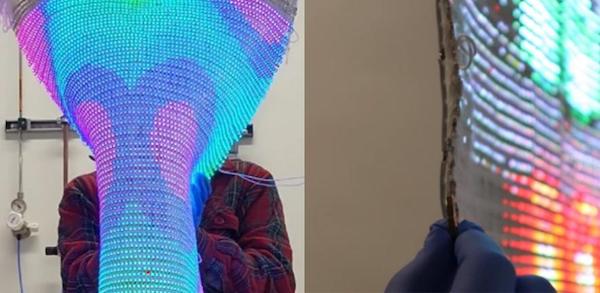
Image via University of Cambridge (CC BY 4.0)
Imagine wearing a T-shirt with an animated print, or charging your phone directly in your trouser pockets.
That technology is very much possible. A team of international scientists led by the University of Cambridge has developed a fully-woven smart textile display that can support electronic functions and smart sensors, as well as harvest energy.
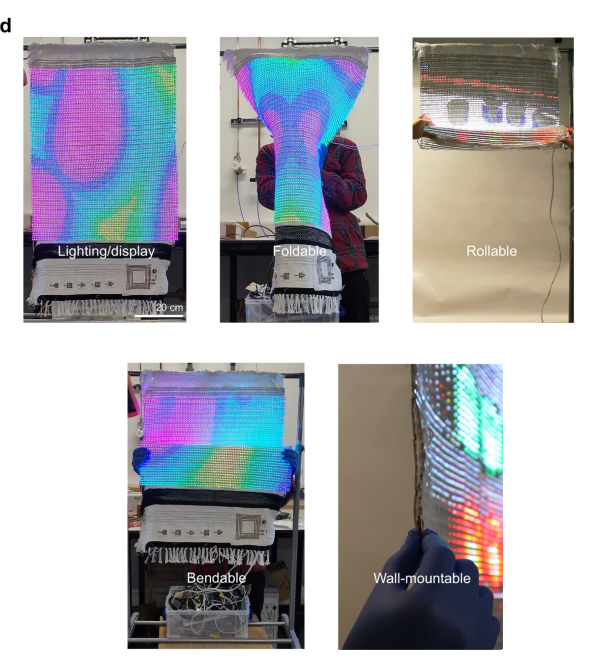
The team suggests that the fabric, measuring 46 inches wide, can be used to create “curtains that are also TVs, energy-harvesting carpets, and interactive, self-powered clothing and fabrics.” This paves the way for “a whole new class of smart devices and systems,” where all sorts of everyday objects can be transformed into smart tools, they describe. Their findings have been published in the Nature Communications scientific journal.
Although inventions like this already exist, the scientists say this one is the first that can be manufactured through typical textile industrial processes and integrate a large, scalable complex system.
Other smart textiles can only work electronically when cut into smaller sizes. They also cannot be produced in the same way fabrics are normally made or woven.
This version, however, is able to embed the functions directly into the textile’s yarns and fibers. The woven fabric remains sturdy as each fiber component is covered with materials that are built to withstand stretching. In addition, some of these fibers are braided for reinforcements. The fiber components are then joined together with conductive adhesives and laser welding.
“The resulting fabric can operate as a display, monitor various inputs, or store energy for later use. The fabric can detect radiofrequency signals, touch, light and temperature,” the team notes. “It can also be rolled up, and because it’s made using commercial textile manufacturing techniques, large rolls of functional fabric could be made this way.”
“By unleashing the full potential of textile manufacturing, we could soon see smart and energy-autonomous Internet of Things devices that are seamlessly integrated into everyday objects and many other sector applications,” says Dr Luigi Occhipinti, one of the project’s collaborators.
Eventually, the team also hopes to turn the fabric into flexible batteries, supercapacitors, solar panels, and more.
[via University of Cambridge and Nature Communications, images via various sources (CC BY 4.0)]


