
Robotic Armband Gives Prosthetic Hands More Dexterity & Efficiency With Objects

Researchers from the Florida Atlantic University have created a robotic armband that can restore more function to users with prosthetic hands using haptic feedback, or touch.
Currently, myoelectric prosthetic hands—which leverage the user’s existing muscles to control movement—only allow users to grasp a singular thing at any one time. At times, they can also be hard to control.
This means that other things like typing on a keyboard or braiding hair are also difficult to carry out because these require the movement and dexterity of individual fingers.
“Examples of multifunction control demonstrated in our study included the proportional control of a card being pinched between the index and middle fingers at the same time that the thumb and little finger were used to unscrew the lid of a water bottle,” Moaed A. Abd, the study’s first author, explains.
“Another simultaneous control demonstration was with a ball that was grasped with three fingers while the little finger was simultaneously used to toggle a light switch.”
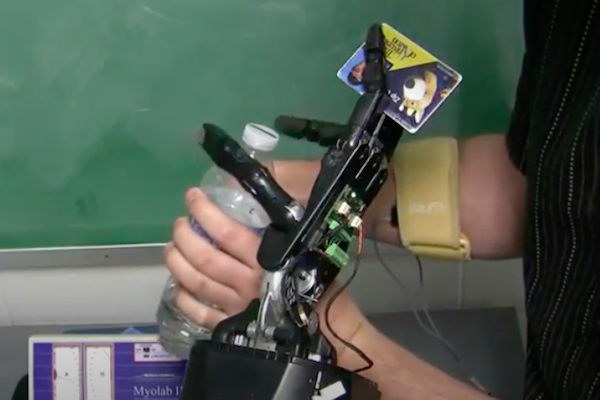
To create the tech, the role of visual feedback in this multitasking action was explored through “methodically obstructing visual and haptic feedback,” a statement from the University writes.
Then, a multichannel soft robotic armband was created so artificial feelings of touch could be conveyed to the user at three points: the thumb, index, and little fingers. Three vibrotactile actuators were also included, which would alert the user if an object was broken from an excess force.
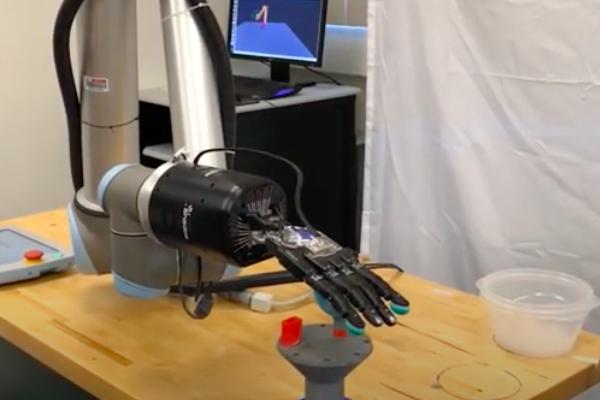
The researchers’ paper, published in the journal Scientific Reports, showed promising results. Multiple sources of haptic feedback could allow those with prosthetic hands to hold and transport two objects at the same time, even if their vision was blocked.
“Researchers did not find significant differences between the limb-absent subject and the other subjects for the key performance metrics in the tasks,” the statement notes.
It was also reported by the subjects testing the armband that haptic feedback was “considerably more important” than visual, because there’s almost zero “visually perceptible warning” before an object is dropped by accident. In contrast, you can feel when something is about to slide out of your hand.
With the implementation of this type of device, opportunities for upper limb-absent people will open up—and a lot more ease of natural movement will be present, too.
[via Tech Xplore and AZoRobotics, images via Florida Atlantic University]


