
Mosquitoes Are Most Attracted To These Colors, And Will Bite
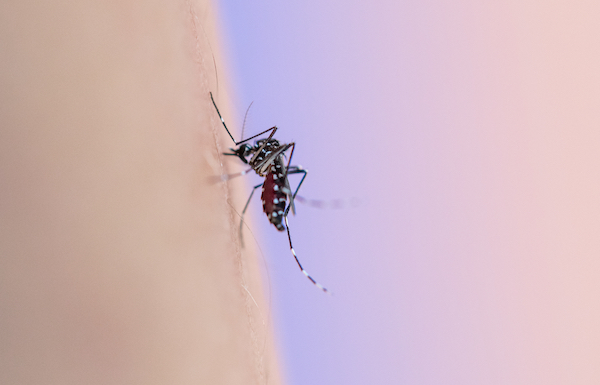
In today’s world, food often must be Instagrammable to whet the appetite. It turns out that this is somewhat true for mosquitoes too, as they’re more likely to swarm around certain colors.
Scientists previously learned that the little buggers react to the odor of carbon dioxide. It’s a sign that humans (and their CO2-dispensing breaths) are around and, therefore, indicates the presence of food.
Biologists at the University of Washington took this revelation with them into a new experiment exploring what attracts mosquitoes, this time incorporating color too.
The team created a visual and olfactory environment to monitor female mosquitoes of the common Aedes aegypti (yellow fever) species and watched their movements via 3D-tracking technology. Colors were introduced in the form of dots.
They discovered that the insects were more attracted to red, orange, black, and cyan, as well as hovered around CO2 for longer periods of time.
Blue, green, purple, and white didn’t dazzle them as much, even if CO2 was sprayed in the area. The team published their findings in the Nature Communications journal.
The same test was conducted with mosquitoes of other species, who reacted similarly. They also lingered in the presence of CO2 and were especially drawn to orange and red. However, violet was a third favorite between the An. stephensi and Cx. quinquefasciatus species.
Interestingly, when the scientists repeated the process with genetically-modified mosquitoes whose CO2-smelling or color vision genes were edited, the mozzies didn’t respond the same. This suggested that both senses have to be intact for the bugs to react to visual cues.
Mosquitoes’ preference for red and orange is telling. It means they’ve come to develop recognition for the color of human skin, which tends to fall in that spectrum. Before this, though, they’ll need to have a sense that sweet human blood is around, and they do this by sniffing for CO2.
“Mosquitoes appear to use odors to help them distinguish what is nearby, like a host to bite,” explains senior author Jeffrey Riffell. “When they smell specific compounds, like CO2 from our breath, that scent stimulates the eyes to scan for specific colors and other visual patterns, which are associated with a potential host, and head to them.”
Humans aren’t all that different, it seems. “Imagine you’re on a sidewalk and you smell pie crust and cinnamon,” Riffell tells Sci-News. “That’s probably a sign that there’s a bakery nearby, and you might start looking around for it.”
[via New Atlas and Hyperallergic, cover photo 148637245 © Piyapong Thongdumhyu | Dreamstime.com]


