
Android Child With ‘Emotions’ Could Help Humans Understand Themselves
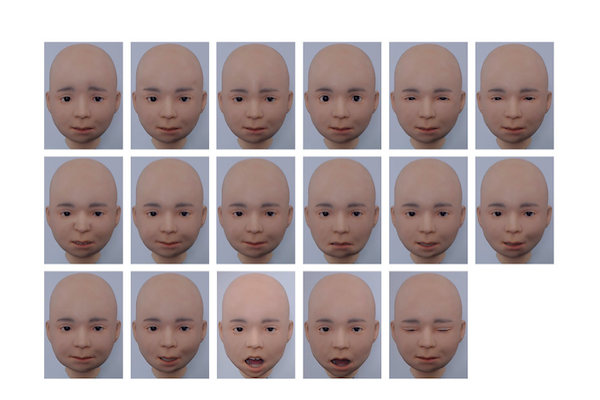
If you thought robots were stoically cold-hearted with no capability of expressing emotion whatsoever, perhaps it’s time to meet ‘Nikola’.
They’re an android child created by the RIKEN Guardian Robot Project, investigating how androids are capable of expressing a variety of emotions. Artificial muscles contort their features according to the displayed emotion, which is just like how us humans work.
29 pneumatic actuators are responsible for the artificial muscles, while a further six control head and eyeball movements, according to The Engineer. Because the former are controlled via air pressure, their movements can be silent and smooth, making them more natural.
These were arranged based on the Facial Action Coding System (FACS), often used to study facial expressions. Some archetypal expression associated with emotions, like a “cheek raiser” when it comes to happiness, were included.
A press release by RIKEN explains that carrying out a “properly controlled” experiment, with live people interacting, is difficult when it comes to studying emotions and how people react to them. But relying on photos or videos results in less natural replications.
“The hope is that with androids like Nikola, we can have our cake and eat it too,” says Wataru Sato, leader of the study published in Frontiers in Psychology. “We can control every aspect of Nikola’s behavior, and at the same time study live interactions.”
Additionally, “androids that can emotionally communicate with us will be useful in a wide range of real-life situations, such as caring for older people, and can promote human wellbeing,” he continues. This is the aim of the Guardian Robot Project.
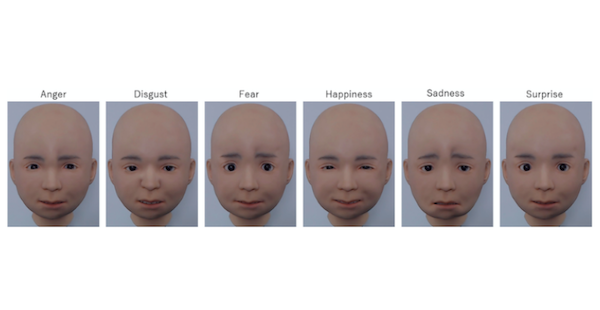
A person with a certification in FACS scoring reported being able to identify each facial action, which shows that Nikola’s expressions are accurate to those of a human.
Members of the public were also able to recognize the six “prototypical emotions”: anger, disgust, fear, happiness, sadness, and surprise. However, since Nikola’s skin can’t wrinkle—as in, “wrinkled their nose in disgust”—some of the guesses weren’t as accurate as they could’ve been.
Nikola can be used in research for social psychology or neuroscience, RIKEN states. There is, perhaps, just one drawback: they don't have a full body. Yet, at least.
[via The Engineer and ScienceDaily, images via RIKEN]


