
Google Is Building Devices That Grasp Body Language & Stay Out Of Personal Space

Video screenshot via Google
Imagine if every piece of furniture and gadget in your home were like an automatic door. Walk up to it at a comfortable distance, or even so subtly give it a glance, and it does what it’s meant to do without being touched.
Google is working on radar sensor technology that can do all that and more. As it is, the existing Soli sensor—which is already built into Pixel phones and the Nest Hub—allows users to navigate their devices by swiping midair, and can even assess sleep quality by tracking how much you toss and turn in bed, Fast Company reports.
These primitive features are destined for evolution. Just like human development, Soli is now learning to pick up social cues that people give off every day.
“We’re really inspired by the way people understand each other,” Leonardo Giusti, Head of Design at Google’s Advanced Technology & Projects (ATAP) Lab, tells the news outlet. “When you walk behind someone, they hold the door open to you. When you reach [for] something, it’s handed to you. As humans, we understand each other intuitively often without saying a word.”
Soli could, for instance, switch off your television if you fall asleep. Via a thermostat by the door, it could also remind you to pick up an umbrella on the way out during rainy weather, pretty much in the same way a family member would as you’re stepping out of the door. Or it could turn on your computer just by a simple look.
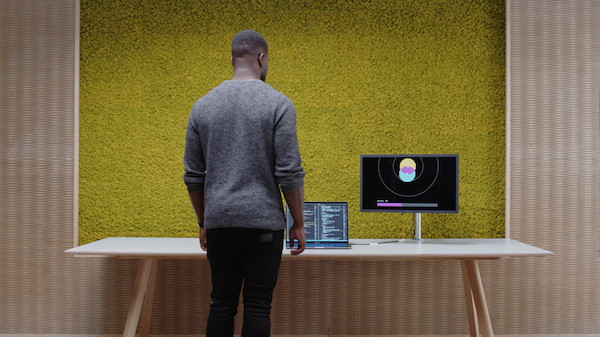
Video screenshot via Google
“As this technology gets more present in our life, it’s fair to ask tech to take a few more cues from us,” Giusti comments. All these add up to Google’s vision of people being “the only interface you need.”
In another scenario demonstrated in a teaser video (shown below), a user is seen cooking in the kitchen while a tablet supported on the table plays a tutorial for a recipe. The user then steps away to collect an ingredient, and the tablet notices this and pauses the video, only resuming the media when she returns. This eliminates pesky gestures, like the need to tap the display with the back of your hand, to play a video.
In the future, a Soli-enabled screen could also light up if you were to glance at it from the other side of the room and offer to make a video call.
But to truly understand social norms, computers will need to grasp people’s need for personal space—and Soli is slowly getting there.
To achieve this, it’s being trained with anthropologist Edward Twitchell Hall’s notion of personal space (or “Proxemics”). Hall, the first to suggest that everyone has a personal bubble, deduced that anything within 18 inches would be considered personal space, with the space inside a 12-foot proximity being a safe distance for conversation. Anything farther from this boundary would be considered public space.
It’s kind of like walking up to someone and making eye contact, which tells the other person that you want to talk to them. Only then will they engage.
[via Fast Company and Tech Times, video and images via Google]


