
‘Drug Factory’ Implant Beads Banish Mice’s Tumors In Under A Week
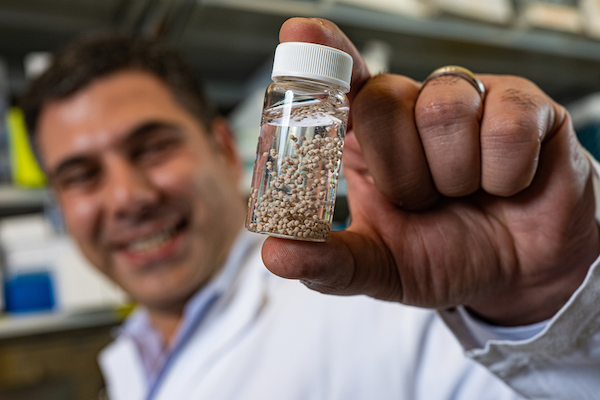
Image via Jeff Fitlow / Rice University
Cancer-fighting beads have cured severe illness in mice in mere days, pointing to a new potential immunotherapy treatment for humans.
The implants, designed by bioengineers at Rice University, produce their own continuous doses in the body, earning the catchy name of “drug factories.” Once administered, they repeatedly and independently manufacture a natural, FDA-approved compound known as interleukin-2—a cytokine that mobilizes white blood cells to remove tumors.
So far, the beads have removed advanced-stage ovarian and colorectal cancer in mice in as few as six days.
“We just administer once, but the drug factories keep making the dose every day, where it’s needed until the cancer is eliminated,” details Omid Veiseh, an assistant professor of bioengineering and the research’s co-author. “Once we determined the correct dose—how many factories we needed—we were able to eradicate tumors in 100% of animals with ovarian cancer and in seven of eight animals with colorectal cancer.” The project is outlined in the Science Advances journal.

Image via Jeff Fitlow / Rice University
Each tiny implant is protected by an outer hydrogel shell, which prevents its contents from being attacked. Although the body’s immunity detects the beads as foreign objects, it won’t take them as immediate threats and attempt to flush them out. This means the beads will be able to keep fighting cancer until it is gone.
The drug factories also only target infected parts and can be deactivated when the treatment is complete to ensure they don’t harm healthy cells.
At the same time, they fix two challenges often associated with anti-cancer drugs: the ability to reach the right cells and delivery in sufficient amounts.
“We found foreign body reactions safely and robustly turned off the flow of cytokine from the capsules within 30 days,” Veiseh elaborates. “We also showed we could safely administer a second course of treatment should it become necessary in the clinic.”
It’s worth stressing that—although the study has been peer-reviewed—the beads have only been tested on mice. Nevertheless, the positive response keeps the scientists hopeful about them working on humans too, and human clinical trials are anticipated by the end of the year to put the implants to proof.
Should the beads prove to be successful, the bioengineers will adapt them to potentially bust other cancers by swapping out the cells stored in the protective layer.
[via New Atlas and ScienceAlert, images by Jeff Fitlow / Rice University via EurekAlert]


