
NASA To Finally Open Lunar Sample That’s Been Sealed For Half A Century
50 years after astronauts Eugene Cernan and Harrison ‘Jack’ Schmitt collected samples of rock and soil from the moon, scientists at NASA will finally be opening the first of two tubes.
During the Apollo 17 mission in 1972, the astronauts hammered a pair of 14-inch-long tubes into the lunar surface, vacuum-sealing one of them while the other was placed in a typical, unsealed container before being brought back to Earth.
Now, scientists at the Johnson Space Center in Houston will be investigating the contents of the sealed tube, harking back to the last time humans set foot on the moon.
“The agency knew science and technology would evolve and allow scientists to study the material in new ways to address new questions in the future,” explained Lori Glaze, Director of the Planetary Science Division.
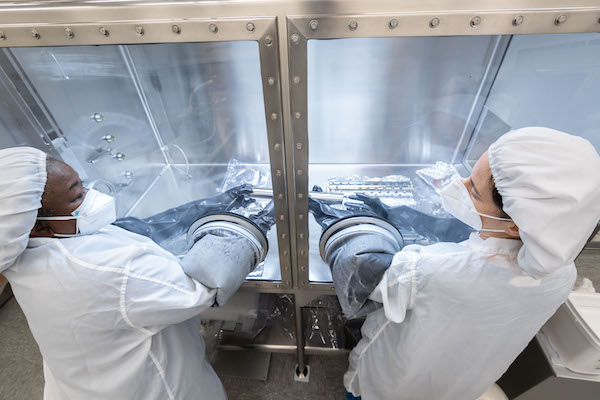
Researchers expect the sample, apart from rock and soil, will contain “volatiles”—gases that evaporate at room temperature—such as water ice and carbon dioxide.
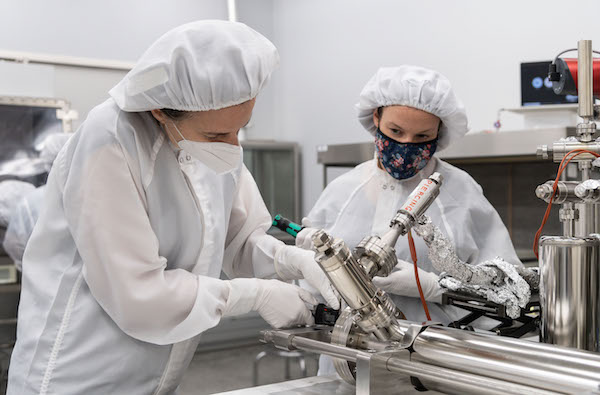
Hence, they will be employing a special device, known as a manifold, designed by a team at Washington University to extract and collect the small amount of gas left over.
According to NPR, a separate tool developed by the European Space Agency (ESA), has been designed to enable scientists to pierce the sample and capture the gases as they escape.
If gases are found, researchers will use modern mass spectrometry technology, which analyzes and measures molecules, to identify the individual components.
“Each gas component that is analyzed can help to tell a different part of the story about the origin and evolution of volatiles on the moon and within the early solar system,” said Francesca McDonald, leader of the project at ESA.
The results could lead to important insight as NASA astronauts plan to head back to the moon for the first time in decades onboard the upcoming Artemis Mission.
[via NPR and NASA, cover image via NASA/James Blair]


