
Archaeologists Discover Many Prehistoric Artists Were Kids, Not Grown Men
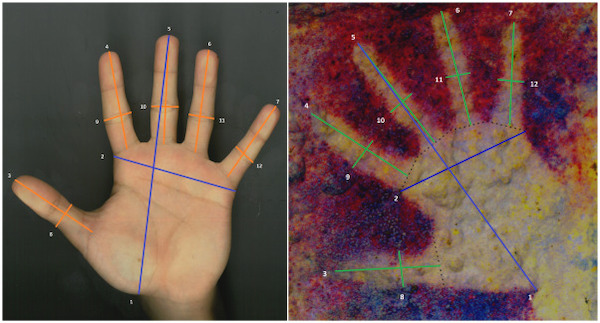
Image via Navarro et al / Journal of Archaeological Science (CC BY 4.0)
Those hand-chickens you painted as a kid? Artists—specifically, children—did those 20,000 years ago.
Archaeologists from Cambridge University and the University of Cantabria in Spain studied 180 prehistoric hand stencils from the Spanish caves of El Castillo, Maltravieso, Fuente de Salín, Fuente del Trucho, and La Gama, and discovered that more prints were created by children—some of them being no older than two years old—than initially thought.
The findings, outlined in the Journal of Archaeological Science, estimate that as many as 25% of the rock paintings had come from the hands of children. Most of the kid-made artworks were created by children between the ages of three and 10, while a smaller subset is attributed to creators aged two to 12.
The revelation suggests that painting could have been a recreational family activity in Paleolithic times instead of something solitary men did for survival.
Palm prints looked larger than they truly were due to the manner in which they were transferred onto the rocks. A child would place their hands on the wall, and pigments would be blown through a hollow reed or bone to outline them in color.
Just as if you were to trace an object with spray paint, the blowing technique produced silhouettes that appeared bigger than the actual subjects.
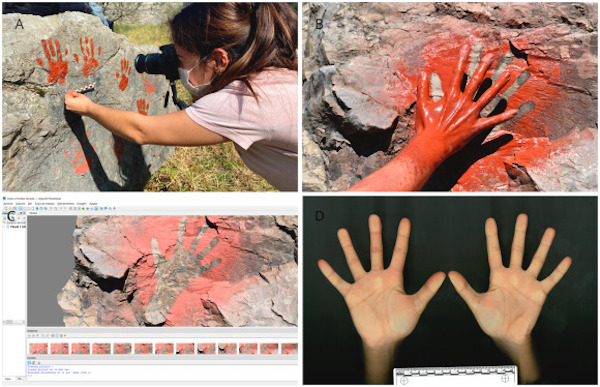
Image via Navarro et al / Journal of Archaeological Science (CC BY 4.0)
Upon close inspection, the scientists learned that many of the hands featured were too small to have belonged to teenagers or adults.
“From the real hand to the one on the wall there are always a few centimeters wrong because the silhouette comes out bigger,” the study’s lead author Verónica Fernández-Navarro tells the Telegraph. “We calculated that error and a lot more children’s hands came out than we expected.”
Since children would not have had the lung capacity to properly transfer the pigments, it can be presumed that grownup supervision was involved. This indicates to researchers that art could have been a family-bonding activity.
The scientists are now attempting to decipher a recurring pattern of bent fingers in some paintings, and wonder if the gestures are signals. “We want to find out if it is a code that they knew how to interpret in the same way that we today interpret a ‘stop’ sign,” notes Navarro.
[via Artnet News and The Telegraph, images via Navarro et al / Journal of Archaeological Science (CC BY 4.0)]


