
NASA Presents First Clear Image Shot By Latest, Most Powerful Space Telescope
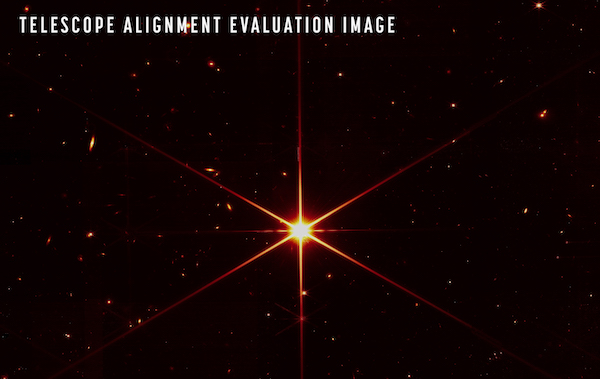
Image via NASA/STScl
Just a month ago, NASA’s James Webb space telescope—the successor to Hubble—took its first images, but they were blurry at best.
In the blink of an eye, the equipment has glowed up and can now capture the sharpest photos it is destined to take. Though, all things considered, it’s been a long time coming. Webb was intended for launch in 2007, but it only did so last Christmas.
Webb’s initial images were of an unnamed star, captured from the 18 individual segments of its main mirror. Stitched into a collage, it was clear that the mirrors were misaligned, and NASA had to make sure they were leveled to compose one synchronized view.
Now, the space agency has reached the milestone of completely aligning the telescope’s mirrors. The progress gives its engineers hope that Webb, the most powerful space telescope, will meet or even surpass its goals.
The achievement is illustrated in a fresh image showcasing a star in the middle and its surrounding galaxies, all of which are finally in focus.
“Webb’s optics and NIRCam [New Infrared Camera] are so sensitive that the galaxies and stars seen in the background show up,” NASA reports.
Marshall Perrin, Webb’s optical telescope element manager, shares in a statement via Ars Technica: “We have now achieved what’s called the diffraction limited alignment of the telescope. The images are focused together as finely as the laws of physics allow.”
“This is as sharp an image as you can get from a telescope this large.”
Perrin concludes that the alignment process, from start to finish, has been smooth-sailing—even with those lackluster images we saw last month. The blurry photos were exactly what NASA had been expecting at the time; they were simply a proof-of-concept that its infrared cameras were working. “At no point in that process did we have any technical issues with the telescope… Honestly, the team was giddy at times looking at this data,” Perrin shares.
NASA’s next step is to align the mirrors with three other instruments; currently, it’s just calibrated with the NIRCam. It aims to complete all alignments by early May.
[via Ars Technica and SlashGear, cover image via NASA/STScl]


