
The Sun Is Snapped At A Dazzling 83 Million Pixels, Giving The Closest Look Yet
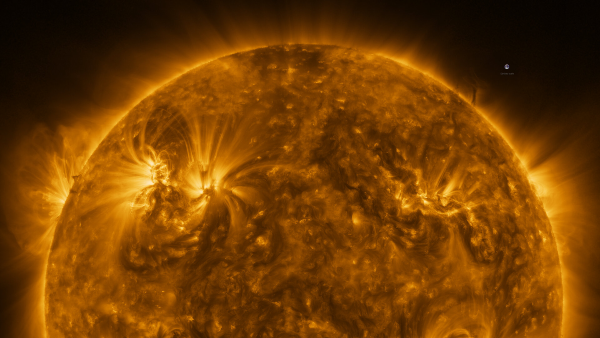
Image via ESA & NASA/Solar Orbiter/EUI team; Data processing: E. Kraaikamp (ROB)
The Solar Orbiter is warming up to the Sun and has taken its closest images of the star yet, producing the most detailed view of its full disc and volatile corona (or outer atmosphere), the European Space Agency (ESA) reveals.
25 images captured of the Sun over a length of four hours on March 7, 2022, form an intensely elaborate mosaic amassing 83 million pixels.
In 2020, the probe traveled 48 million miles up close to observe the hot star. This time around, it went two million miles closer, staying right smack in the middle of Earth and the Sun, at a distance of 46 million miles from each of the two.
The result of the research is an incredible image with a quality 10 times better than a 4K television. The entire image spans a 9,148 by 9,112-pixel grid.
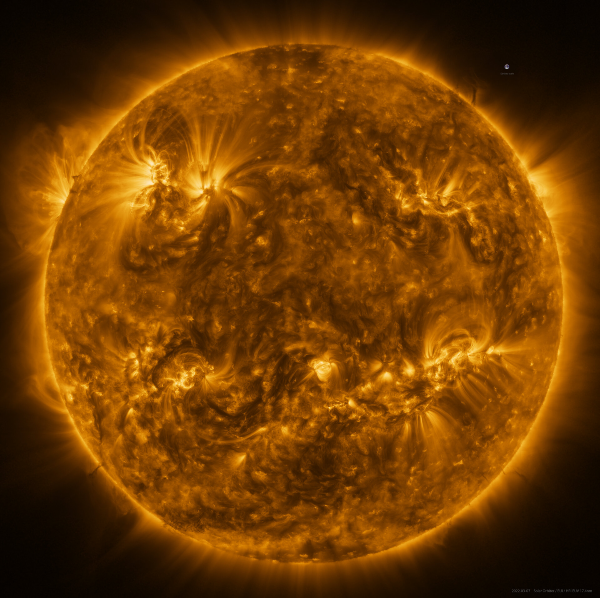
Image via ESA & NASA/Solar Orbiter/EUI team; Data processing: E. Kraaikamp (ROB)
At the two o’ clock and eight o’ clock areas of the collage, you’ll spot the Sun’s turbulent dark filaments projecting from its exterior. Those, according to the ESA, are “prone to erupt” and can blast large amounts of coronal gas into the surroundings, causing space weather storms.
You can explore the Sun—or at least an interactive, ultra-high-res image of it that you can zoom in on—or download the still here.
Notably, this field trip also saw the use of Solar Orbiter’s Spectral Imaging of the Coronal Environment (SPICE) instrument, which is aimed to help scientists better understand the Sun’s enigmatic thermal qualities. The atmosphere actually gets hotter the farther you get from the star; the corona can reach temperatures of 1.8 million degrees Fahrenheit, while the surface itself is just 9,000 degrees Fahrenheit.
All this comes ahead of Solar Orbiter’s first-ever close pass of the Sun, which will take place on March 26. It’ll be all systems go at this solar flyby as scientists attempt to pack in as much data as they can. Going forward, literally, the spacecraft will get closer and closer to the Sun.
[via Gizmodo and Space, cover image via ESA & NASA/Solar Orbiter/EUI team]


