
A More Natural Wearable ‘Larynx’ Restores Power In Those Who’ve Lost Their Voice
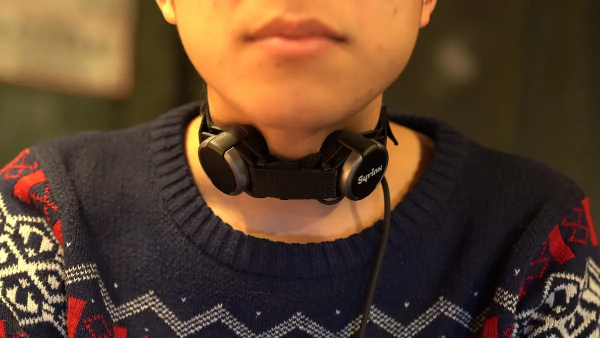
Image via Syrinx
In any language in the world, taking someone’s voice is to deprive them of their identity. Unfortunately, those diagnosed with laryngeal cancers—more than 184,000 people around the world, as per the World Health Organization—would often have to have their voice boxes surgically removed. Learning to speak again without the presence of a physical larynx is a difficult undertaking, as one can imagine.
In recovery, there are three main options that re-train patients to communicate verbally, speech-language pathologist Yvonne Knapp tells CNN.
There’s esophageal speech, a technique in which a person learns to create vibrations on the throat and turn them into speech. This is the oldest and most difficult rehabilitation method, and only 5% of patients have been able to communicate successfully with it. There’s also the tracheoesophageal puncture, where a small incision is made between the trachea and esophagus to make way for a speech-inducing prosthesis—but this procedure isn’t for everyone.
The other solution is a wearable voice box, called an electrolarynx, which the speaker can hold up against their neck to convert tongue and lip movements, as well as vibrations, into sound. The traditional electrolarynx hasn’t changed much since its invention in the last century, and voices emitted from it can sound loud and robotic. As per Knapp, users have felt embarrassed when utilizing this and don’t care to use it in the long term.
Engineer Masaki Takeuchi and his team at the University of Tokyo have been hoping to revamp the awkward experience of conversing after losing one’s voice. In 2019, they invented the ‘Syrinx’, a modern electrolarynx that’s hands-free, more natural-sounding, and uses machine learning.
The device, wearable like a neck brace, produces a more natural-sounding voice thanks to the use of human recordings and the presence of two sound-producing electromechanical vibrators called transducers (instead of one), enabling a wider spectrum of sound-wave frequencies transmitted through tongue and lip movements.
The team is constantly updating the gadget, and is even considering adding the user’s original voice into it via existing audio clips to help them reconnect with their identity. There has been some back and forth about deploying artificial intelligence to make voices sound more humanlike, and the firm is intending to bring it back in an updated version.
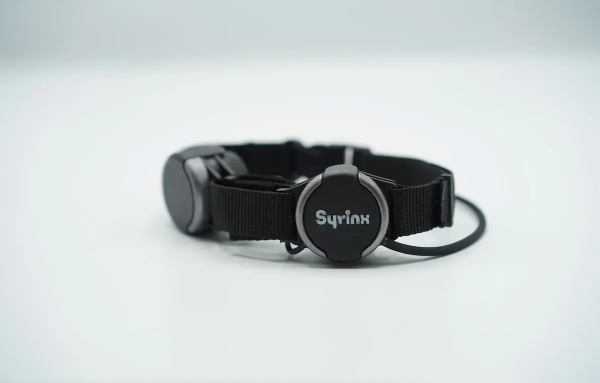
Image via Syrinx
In contrast with the traditional electrolarynx, Syrinx does not have to be held, allowing the speaker the freedom to communicate with their hands again “like a healthy person,” Takeuchi tells the news outlet.
The wearable larynx is frequently being tested by cancer survivors who have had voice box surgery. Having tried the latest iteration, 75-year-old Takashi Sugiyami finds that it is more comfortable now, although the verbal output still sounds a little robotic. He believes its material could be more stretchable to fit snugly around the throat.
Syrinx might still be in its early stages, but it’s already amassed great acclaim in Asia. Moving forward, its creators hope to expand globally and have the gadget tested by US patients.


