
Activists Damage Old Painting’s Frame After Gluing Themselves To Art In Protest
Earlier this month, it was reported that environmental activists had glued themselves to a Vincent van Gogh landscape painting at the Courtauld Gallery in London, in a bid to protest the new oil and gas regulations in the UK. The young campaigners, who were part of the Just Stop Oil organization, stuck their hands onto Peach Trees in Blossom (1889), hoping to stir up feelings of alarm at what could possibly befall the work’s featured Provence region if nothing is done about climate change.
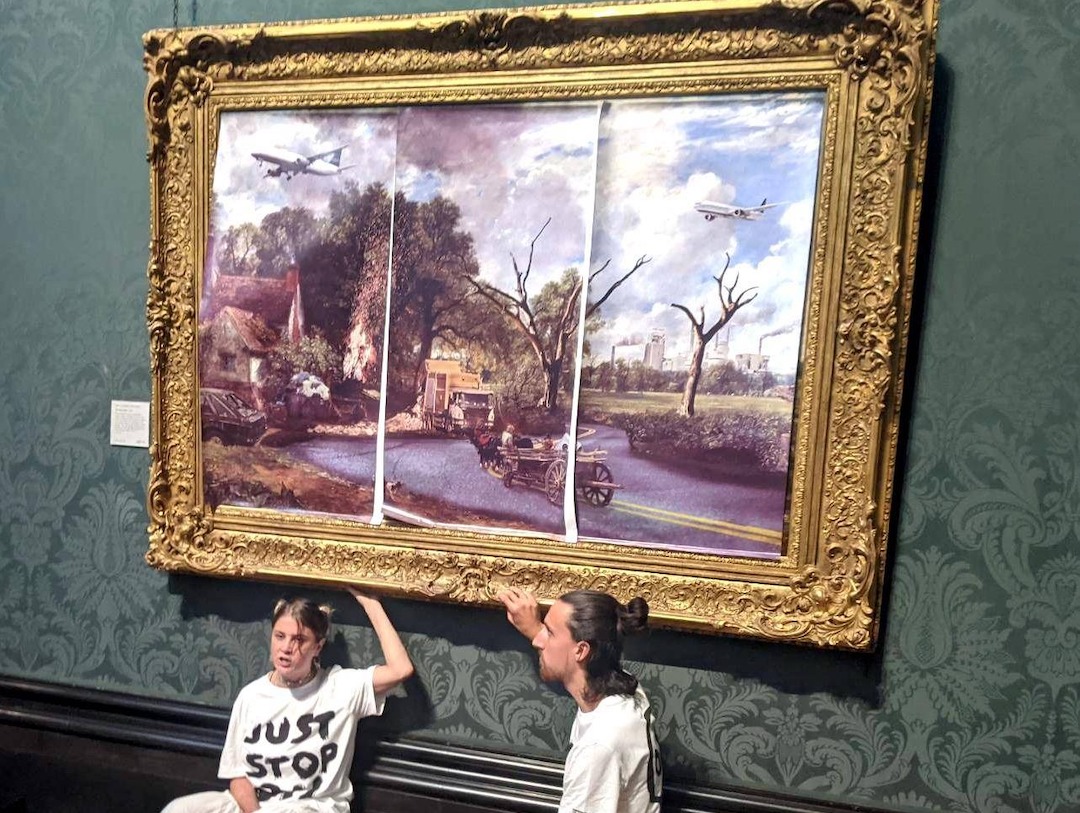
Now, two supporters have glued themselves to yet another painting, this time onto the frame of a Constable work at the National Gallery in London, but not before covering the artist’s depiction with a reimagined version of how it should look.
John Constable’s Hay Wain (1821), arguably his most famous work, portrays a picturesque landscape of the millpond at Flatford on the River Stour in Suffolk. The activists’ version is less appealing, showing a “nightmare scene” of how oil has destroyed the countryside.
Instead of flora and fauna, the river in the image has been replaced with a road, airplanes crowd the sky, pollution spews from cities nearby, old cars litter the Mill, and the surrounding trees are scorched by wildfires from rising temperatures.
“You can forget our ‘green and pleasant land’ when further oil extraction will lead to widespread crop failures, which means we will be fighting for food. Ultimately, new fossil fuels are a death project by our government,” said Hannah Hunt, a psychology student from Brighton who took part in the protest.
“So yes, there is glue on the frame of this painting but there is blood on the hands of our government,” she added, addressing the outcry that the piece’s frame had been damaged in the process.
A spokesperson for the National Gallery told The Art Newspaper the painting had suffered “minor damage to its frame” and “disruption to the surface of the varnish,” though both details have since been fixed and the work rehung.
To Eben Lazarus, the other participant in the protest, while the painting “is an important part” of the country’s heritage, it undeniably isn’t more important than “the 3.5 billion men, women, and children already in danger because of the climate crisis.”
[via The Art Newspaper and Just Stop Oil, cover image via Just Stop Oil]


