
AI ‘Ghost Imaging’ Uses Brainwaves To Help Humans See Through Walls

‘Ghost Imaging’ is an AI technique that is as close to X-ray vision as we are going to get… for now. It’s a system that taps into the brainwaves of a human being to see around corners or through obstacles. The technology will make its debut at the Optica Imaging and Applied Objects Congress which is being held from July 11 to July 15.
A team from the University of Glasgow has taught an AI to examine the brainwaves of a human as they look at light patterns on a wall. This is part of an emerging area of technology called non-line-of-sight (NLoS). Previously, it relied on a laser that caught the scattered light on a wall and beamed the image back to a camera for the AI to read. Now, the camera has been replaced by the human eye.
During the test, human subjects had to wear an electroencephalogram (EEG) helmet while viewing distorted light on a distant wall. Behind the wall separating them and the object were a 2D image and a projector that bounced light off of the image.
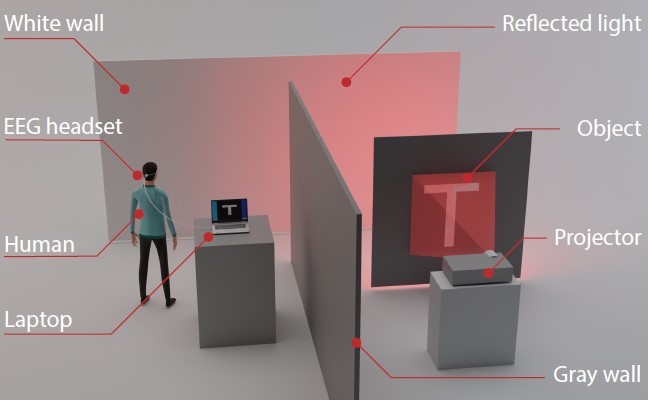
As the human viewed the light, the AI could read the brainwaves and compute what the image was by studying the curves of the light patterns. The strength of the light affected the AI’s ability to accurately conjure up the object.
Each test image was approximately a 16 x 16-pixel image, and the light frequency flickered at 6Hz for two seconds. Ultimately, it only took the AI a minute to correctly guess the image.
A Professor of Quantum Technologies at the University of Glasgow, Daniele Faccio, said that this experiment was just the first step towards a myriad of possibilities of how AI and humans could work together. It was also stated that future experiments will comprise 3D objects.
[via Analytics Insight and New Atlas, images via various sources]


