
Mercedes Is First Major Sporting Brand To Soar With Sustainable Aviation Fuel
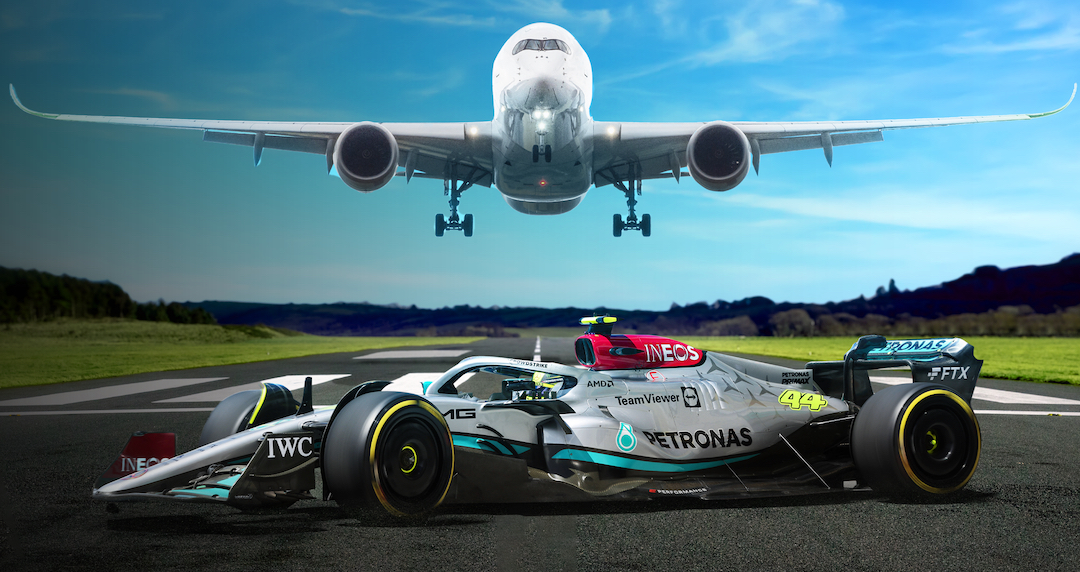
You’d be forgiven for thinking that 20 cars circling tracks over hundreds of laps per season would be the highest contributor to Formula One’s carbon emissions as a sport.
However, as per Thred, that isn’t the case, and the culprit isn’t the number of tires used either, which only account for 0.7% of the sport’s emissions. It turns out that most of the pollution generated by F1 comes as a result of the numerous long-haul flights undertaken by drivers, equipment, and staff as they jetset across the world.
As such, the Mercedes-AMG Petronas F1 Team is looking into alternative fuels as it inches closer to its goal of becoming a net-zero entity by the end of the decade, setting its sights on sustainable aviation fuel (SAF) in hopes of lowering international aviation emissions. It now prides itself as the “first major global sporting brand to take on a commitment to Sustainable Aviation Fuel.”
According to the team, SAF is a form of renewable fuel made from sustainable resources, known as feedstocks, including forestry and agricultural waste, used cooking oil, and even carbon captured from the air.
This means that instead of just adding carbon to the atmosphere, it recycles previously produced emissions, with the International Air Transportation Association estimating the new fuel could reduce overall aviation emissions by 65% and help the industry achieve net zero by 2050.
SAF can be easily switched in for traditional jet fuels, requiring no additional parts or technology to be changed within the aircraft. Plus, it’s said to reduce harmful emissions, such as particulates and sulphur, by 90% and 100% respectively, further protecting our planet and the air we breathe.
Going forward, Mercedes’ investment in SAF will cover the team’s flights to the various Grand Prix locations on the calendar, including other business air travel by race team personnel, which is expected to reduce its air travel footprint by up to 50%.
[via Thred and Mercedes-AMG Petronas F1 Team, cover image via Mercedes-AMG Petronas F1 Team]


