
NASA Discovers Lunar Pits That’ll Make For Comfortable Hideouts For Humans
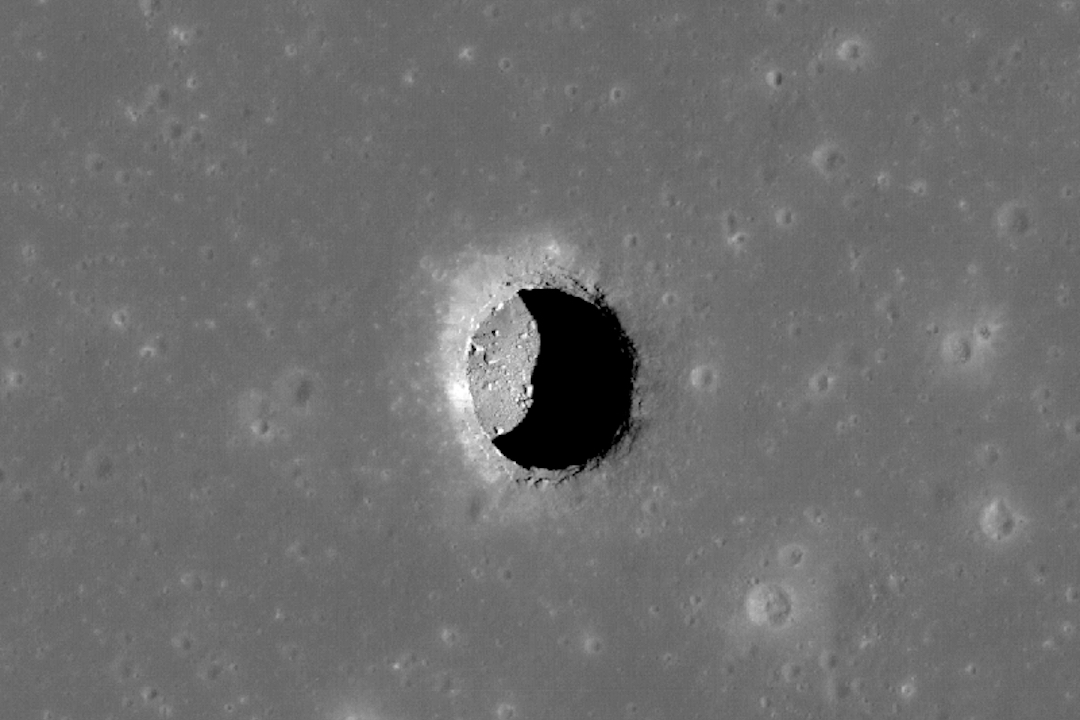
Using recent data from NASA’s Lunar Reconnaissance Orbiter (LRO), scientists have discovered that several shaded spots, located within lunar pits, constantly maintain a comfortable temperature, making them the best possible hideouts if you ever find yourself stranded on the Moon.
Hovering around 63°F, these pits—and the caves to which they may be connected—could be the best sites for astronauts to hunker down in when conducting lunar exploration expeditions, considering surface temperatures can reach up to 260°F in the day and plunge to -280°F at night.
Interestingly, a “full day” on the Moon doesn’t last 24 hours as on Earth, with La Luna experiencing a “day” that lasts the equivalent of 15 Earth days, during which the surface is bathed in constantly sunlight. It then switches to 15 Earth days’ worth of “night,” when temperatures plummet.
“Lunar pits are a fascinating feature on the lunar surface. Knowing that they create a stable thermal environment helps us paint a picture of these unique lunar features and the prospect of one day exploring them,” quipped LRO Project Scientist Noah Petro.
The researchers posit that 16 of the over 200 pits found are likely collapsed lava tubes, which form when molten lava flows beneath a field of cooled lava, or when a crust forms over a river of lava—carving out long, hollow tunnels that turn into pits when the ceilings collapse.
According to NASA, two of the most prominent pits spotted have visible overhangs that lead into large caves or voids, and could be potential exploration sites when astronauts finally head back to the Moon.
“Humans evolved living in caves, and to caves we might return when we live on the Moon,” remarked David Paige, co-author of the paper who leads the Diviner Lunar Radiometer Experiment aboard the LRO.
Temperatures at the surface of the Moon vary widely, from 260 F (about 127 C) during the day to minus 280 F (about minus 173 C) at night. Hanging out at a stable 63 F (17 C) sounds much more pleasant. https://t.co/K0sm1CLqal pic.twitter.com/0Nq1l68iNp
— NASA Moon (@NASAMoon) July 26, 2022
[via Mashable and NASA, cover image via NASA / Goddard / Arizona State University]


