
Doctors Save Newborn Baby Girl’s Life With 3D-Printed Skull
Brain surgeries are among the most complex operations in the medical field, and even more so when the patient is a baby, requiring greater delicacy, precision, and an almost immediate response.
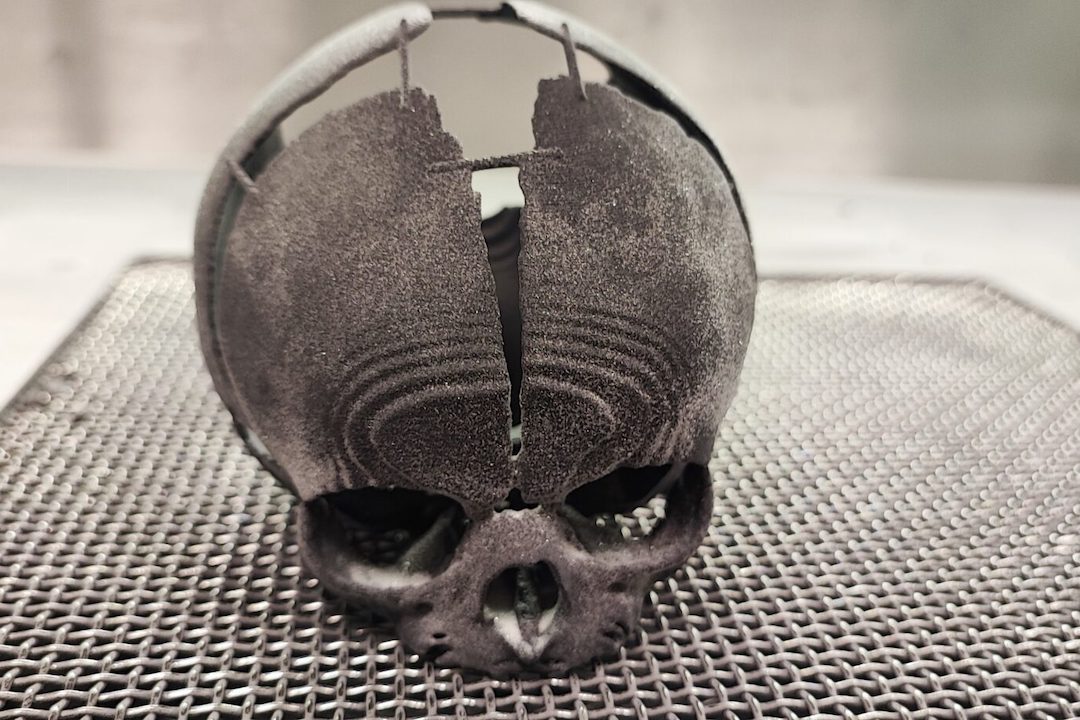
As such, when Warsaw-based Sygnis was approached by Pawel Ozga, a specialist in medical imaging segmentation and a volunteer with the e-Nable Poland Foundation, the team jumped at the chance to 3D-print a pre-operative skull model of a baby girl, who supposedly only had four days to live.
According to the company, the newborn was born with only one-fifth of her skull and lacked a fully-formed occipital bone. This meant part of her brain tissue was exposed and she required immediate surgery.
The baby was brought to the Neonatal Pathology and Intensive Care Unit at the University Children’s Hospital in Krakow, where Professor Lukasz Krakowczyk of the Oncology Center in Gliwice headed the gargantuan task of operating on her for the specialized defect.

Basing its real-life model on a virtual image of the skull, Sygnis prepared the 3D-printed skull using magnetic resonance imaging (MRI) and computed tomography (CT), creating it in record time—just 96 hours—so doctors had enough time to predict the conditions of the newborn’s surgery.
To ensure there were no mishaps during the printing process, the firm used two different methods of preparing the skull. The first model was processed using selective laser sintering (SLS) technology, which took 24 hours; while the latter made use of SLA technology (involving curing light-sensitive resins), taking only eight hours.
Fortunately, after the models were shipped off to the hospital, the team received news that the operation had been a success, with Professor Krakowczyk emphasizing that “3D printing will also be essential at the stage of reconstruction of the skull bone defect.”
Following this life-saving procedure, Sygnis teamed up with Katowice Hospital to engineer a model of a seven-year-old’s spine to aid in the child’s surgery. It plans to continue offering similar services to medical centers going forward.

[via Interesting Engineering and Sygnis, images via Sygnis]


