
Physics-Defying Robot Could Get Near Black Holes Without Succumbing To Pressure
Black holes are a phenomenon that has mostly been studied from a distance. Scientists at the Georgia Institute of Technology are now in search for more answers—they have created a robot to defy gravity and the laws of physics to understand the voids better.
Whether we’re standing still or walking about, our bodies are always facing some sort of pressure, even if we can’t feel it. However, with this new robot, researchers have found a way for it to move around in curved spaces without feeling that same force.
The project’s main goal was to study how an object could make its way around a curved area, like a black hole, without coming into contact with its surroundings.
The result was a robot that was placed on a sphere to keep it isolated and allow it to freely explore its curvature effects.
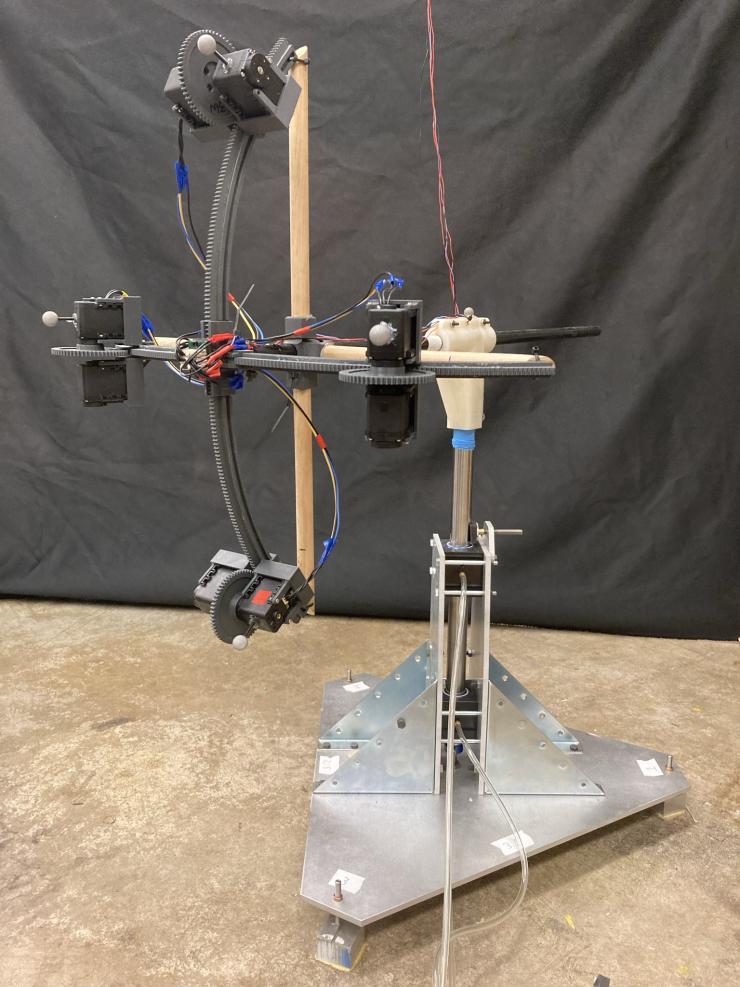
In order to recreate the environment of a great void, motors were set up strategically around the robot as it was attached to a rotating shaft. The shaft was adjusted to reduce the pull of gravity and air bearings to reduce friction were used instead to support it.
Ultimately, a whole new environment was created around the robot as it moved against—or rather, with—its new fabricated world.
In an announcement, the head of the study, Zeb Rocklin, described the robot as a “shape-changing object” or a “swimmer” that transformed as it moved around on its sphere in a way that showed it was not tethered to environmental laws.
According to the study, other physicists had dismissed the notion that something could ever worm its way around a black hole due to the fact that the predicted outcome of the study was ultimately counter-intuitive.
Eventually, with more advancements, this robot could help us navigate through the complex conditions of a black hole.
Rocklin hopes to inspire other researchers to conduct their own experiments using this new curved effect instead of just thinking along a literal and figurative straight line of thought.
[via TechTimes and TheTechOutlook, images via various sources]


