
Google’s Robots Are Being Trained To Intelligently Perceive Social Human Cues
Robots, as we know them, are not as intuitive as sci-fi movies make them out to be. Right now, they’re still at a level that can only understand humans through clear, literal instructions given to them.
On the other hand, Google is attempting to break down this communication barrier by teaching artificial intelligence and robots to understand subtle cues from their human counterparts.
The tech company has begun installing its PaLM (Pathways Language Model) language learning system into a few test droids from parent company Alphabet’s Everyday Robots.
To train PaLM, a 6,144-processor taught on books, jokes, conversations, and Wikipedia articles, was programmed into the bots. It was rendered with an ability to finish sentences and understand jokes.
As a result, the PaLM-SayCan model was created to install reinforcement learning, learning via imitation, and simulation learning into its fleet of robots.
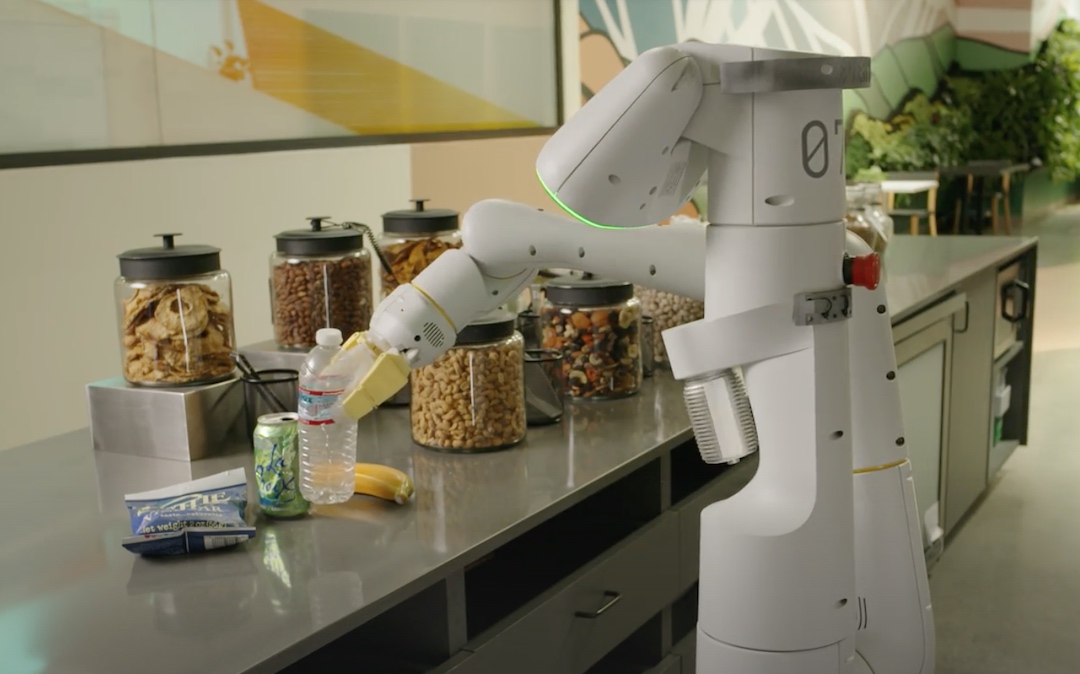
The robot itself is a tubular device that has a robotic arm that can unfold and a set of wheels to glide on. Cameras are placed inside of its “head” so it can see its environment.
Now, PaLM-SayCan allows the machines to pick up on cues and interpret vague instructions presented to them. To properly prepare the robot for everyday use, it was trained in an office and a kitchen to better adapt it to real life.
For example, during the tests, the following instruction was given to the robot: “I’ve spilled my drink. Can you help?”
The robot was able to understand what was being asked of it. It headed to the drawers, picked up a sponge, and then back to where the drink had been spilled. However, it was not able to wipe up the drink as it had not yet been programmed to do such a task yet.
In order to understand the command, the robot was equipped with deep-learning AI to process the subtleties of the human language and interpret requests such as this one.
To achieve what was being asked, the droid would have to break down the task, process what was being said, and then create its own end goal by itself without being specifically asked to grab a sponge.
Its abstract understanding of the world has also given it the ability to locate drawers and cabinets and differentiate between different brands of snacks and drinks.
Other complex tasks, such as telling the robot you have just finished a workout and need a drink and snack to recover, were given to the robot, and it instantly perceived that the user was looking for a bottle of water and an apple.
Another fleet of robots was set loose in an office setting where they were allowed to glide around and learn politeness from the employees working around them.
[via CNET and Analytics Insight, cover image via Google]


