
Europe’s Switch To LED Lights Can Be Seen From Space, Now Shines To New Risks
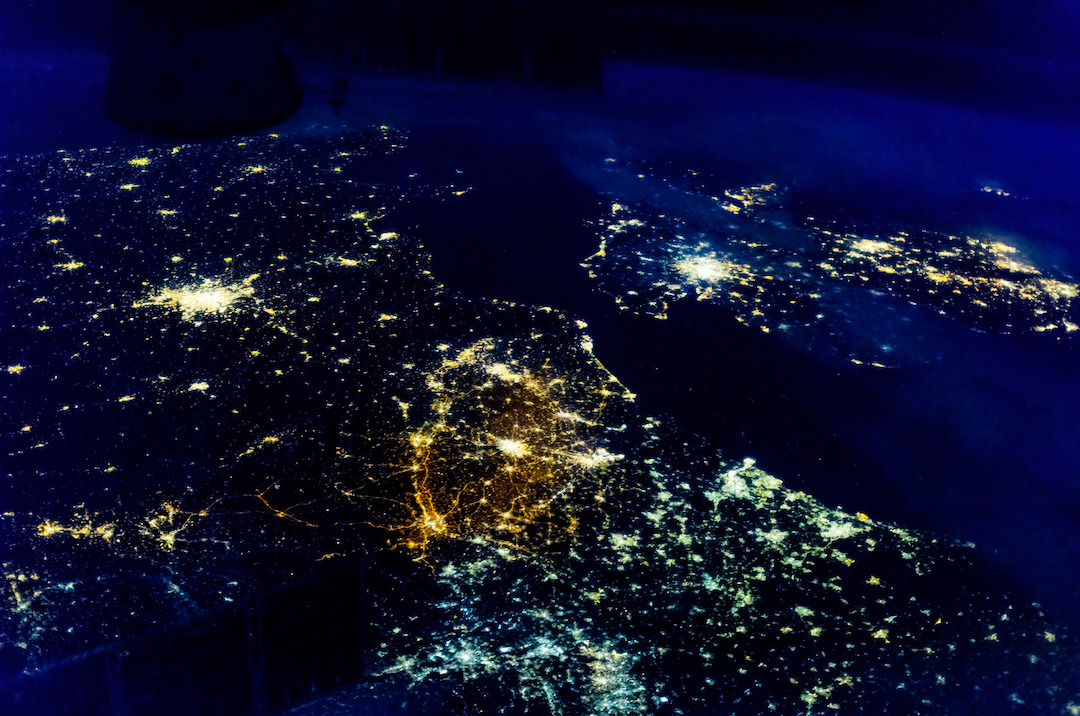
Europe is turning blue as LED lights are increasingly used around the continent.
The switch to LED bulbs in street lamps in different countries is part of a move to be more eco-friendly. However, after satellite images were released in a study published in Science Advances, scientists are now concerned about the detrimental effects of this transition on the environment.
The team behind these findings studied this change in Europe by collating photos taken on Nikon D3, D3S, D4, and D5 DSLR cameras from the International Space Station. The images were collected over six years and showed changes between 2012 and 2013 and 2014 to 2020.
They found that the UK, Ireland, and Italy were the most significant adopters of LED bulbs, while Belgium and Germany were the slowest on the continent to do so.
Aside from the apparent light pollution that the street lamps are contributing to, researchers have also found that using these bulbs can disrupt the living cycles of animals and humans.
So, how does the blue glow of LEDs differ from the yellow hues of high-pressure sodium bulbs? Well, it mainly disrupts our sleep.
Blue light inhibits the production of melatonin, the hormone we need to make us sleepy. As humans, there are several lifestyle changes we can act on to reduce disruptions. However, animals can’t differentiate between natural and man-made light sources.
According to the lead scientist in the study, Alejandro Sánchez de Miguel, an astrophysicist at the University of Exeter, the nighttime is crucial for animals as it is a time to hunt, forage, and pollinate. The introduction of LEDs could heavily throw them off their natural life cycle.
Sánchez de Miguel also notes in the study that switching to what is thought of as eco-friendly lamps is not even helping the environment save energy. While it might seem like it, adopting these artificial lights is not being done sustainably and is still considered a pollutant and a waste of energy.
However, it is all not in vain. The director of the Institute of Sleep Medicine at Staten Island University Hospital, Thomas Kilkenny, mentions that the bright blue hues can help make drivers feel more alert on the roads.
According to the researchers, this study is one of the first that maps out the light spectrum of Europe at night. They hope to do the same across the entire world in the future for a better picture of how artificial rays affect everyone on Earth.
[via DIY Photograpy and Popular Science, images via Sánchez et. al., Science Advances]


